
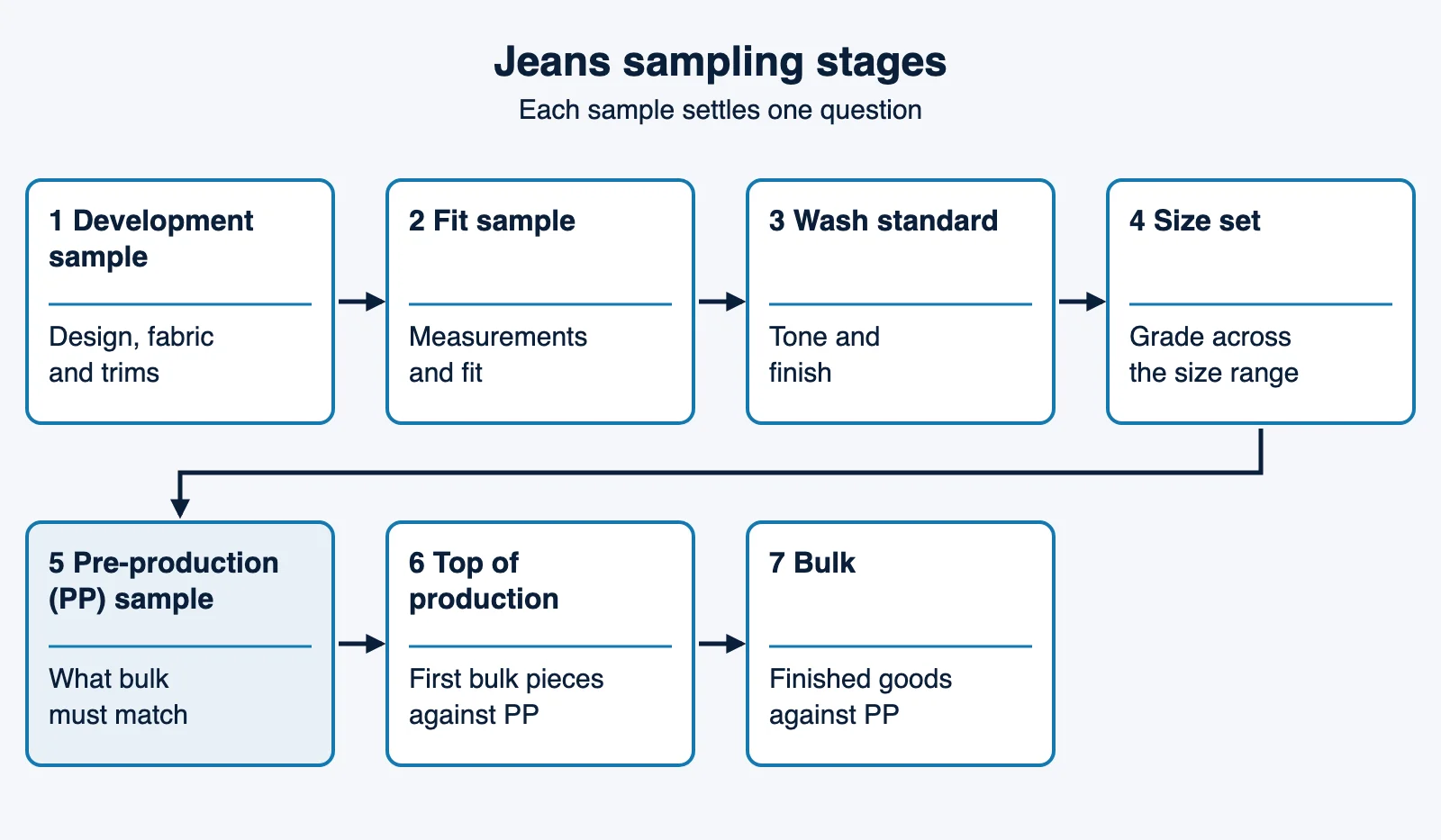
The jeans sampling process has six checkpoints: development sample, fit sample, wash standard, size set, pre-production (PP) sample and top of production. Each answers one question, measurements are taken after the wash, and a change that alters what the signed sample proved needs a new round.
The jeans sampling process runs in stages, and each sample answers one question: the first sample checks design, fabric and trims, the fit sample checks measurements, the wash standard fixes the tone, the size set checks the grade, and the pre-production (PP) sample is the one bulk has to match. At Kuzgunlar the first sample takes 7 to 10 days once the brief is clear.
This guide is for brands that have already picked a factory and now have to run the samples. It covers what each sample is for, what it is made with, who signs it off, how to write comments the factory can act on and which changes need another round. Choosing the factory comes first and is covered in how to choose a denim manufacturer.
What are the stages of the jeans sampling process?
There are six checkpoints between the brief and bulk. Brands name them differently, so agree the names in your first email. This guide uses the names in the table below, and the steps around them, from pattern to packing, are in our guide to the jeans production process.
| Sample | Question it answers | Made with | Who approves |
|---|---|---|---|
| Development (first) sample | Do the design, details and fabric match the brief? | Fabric and trims from the brief. A substitute is marked on the sample. | Your product developer or designer |
| Fit sample | Do the measurements and the fit on the body match the spec? | Final or near-final fabric. If it differs from bulk, the comments say so. | Your technical designer, after a fit session |
| Wash standard | Does the washed tone and finish match the reference? | Bulk fabric, washed to the finish you want | You approve the look, and the factory confirms it can repeat it |
| Size set | Does the grade hold across the size range? | Bulk fabric and the approved wash, in the sizes you choose | Your technical team |
| Pre-production (PP) sample | Is this exactly what bulk will be? | Bulk fabric, trims, labels and the approved wash | You sign it, and both sides keep a copy |
| Top of production (TOP) | Do the first bulk pieces match the PP sample? | Pieces from the bulk run | You or your inspector, with the factory's quality control |
Summarize this article with AI Open a summary of this article in your preferred assistant
Development and fit samples: what each one settles
The first sample is where your fabric, trims and labels meet the brief. We make it with the fabric and trims sourced to your brief, 7 to 10 days after the brief is clear. Our guide to the jeans tech pack covers what a clear brief contains.
Judge the first sample on look and construction: pocket shape, stitching, hardware, label placement and the direction of the wash. Fit comes in the next round. A fit judged on a first sample cut from a stand-in fabric can send the pattern in the wrong direction.
The fit sample is where the spec gets tested on a body or a form. The fabric matters here. A fit sample cut from a different fabric than bulk will measure differently after the wash, so name the fabric on the sample and in the comments. Fabric weight and stretch also change how a pattern behaves, which our guide to denim weight for jeans explains, and the pattern itself differs between cuts, as covered in men's and women's jeans.
Approving the wash standard and measuring after the wash
A wash standard is a physical reference, a washed garment or swatch that you sign. The factory matches the wash to it. At Kuzgunlar we match the wash to the approved wash standard and compare the wash tone against it during production. The wash types themselves are explained in our guide to denim washing techniques.
Look at the standard and the sample side by side under one light, and write that light into the comments. Denim reads differently under a warehouse tube and under daylight, so two people on two sides of a table can disagree about the same pair.
Measure after the wash as well. Jeans change in length and width when they are laundered, and AATCC TM150 exists to measure that change: it determines the length and width changes of garments when subjected to home laundering procedures. ISO 5077 specifies a method for the dimensional change of fabrics, garments or other textile articles after specified washing and drying procedures. A measurement taken before the wash describes the pattern. A measurement taken after the wash describes the pair your customer will put on.
When you order a test report, name the method on the spec. The AATCC page notes that its method may not be applicable to garments made of certain stretch fabrics, so agree the method with your lab when the fabric stretches.
How to write sample comments the factory can use
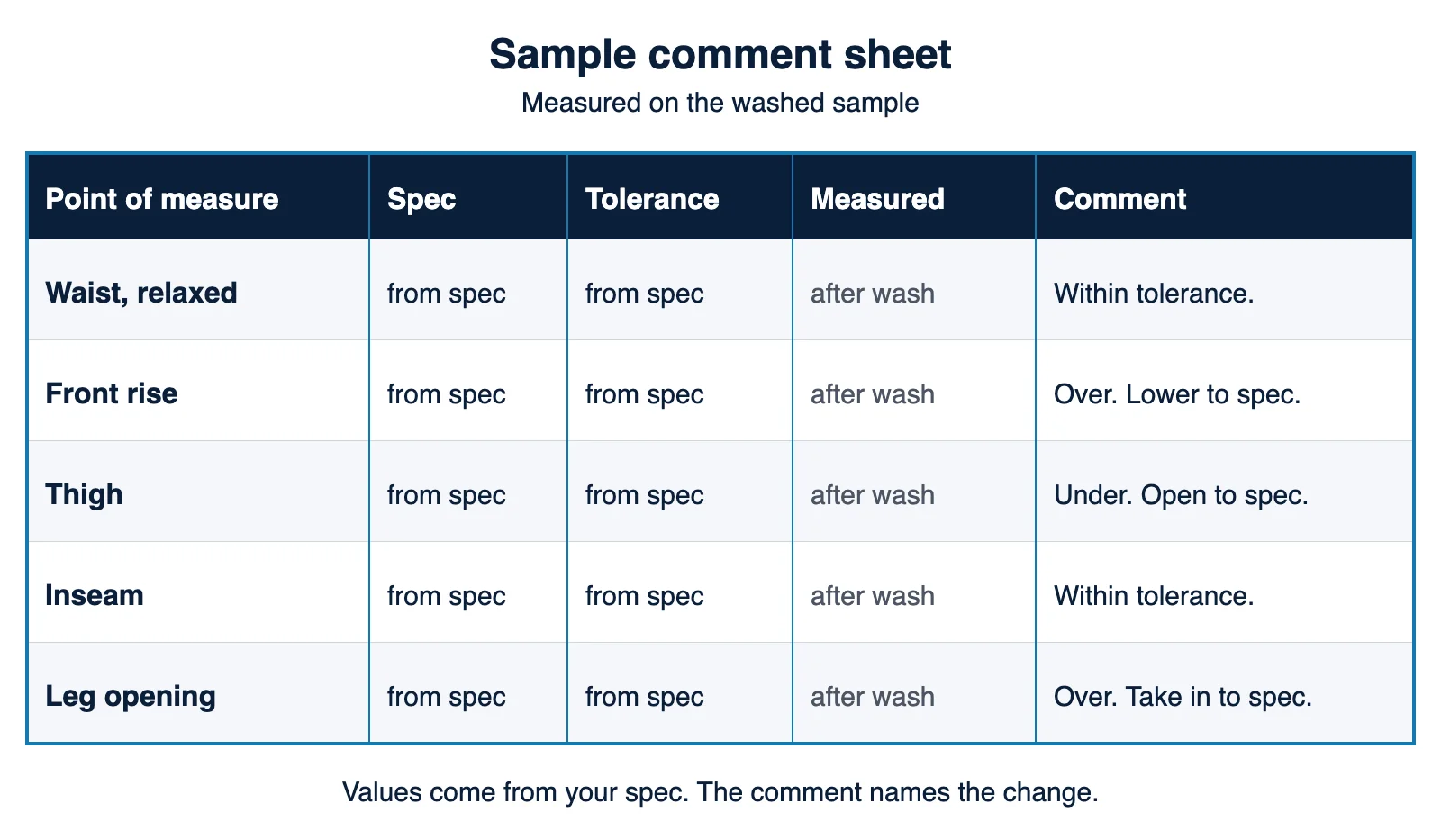
A comment works when it names the point of measure, the spec, the tolerance, the measured value and the action. "Too tight" starts a conversation. "Thigh measured after the wash is over tolerance, bring it to spec" ends one. Your spec sets the tolerance, and the comment sheet only repeats it.
| Point of measure | Spec | Tolerance | Measured after wash | Comment |
|---|---|---|---|---|
| Waist, relaxed | from your spec | from your spec | your measurement | Within tolerance. Keep. |
| Front rise | from your spec | from your spec | your measurement | Over tolerance. Lower the front rise to spec and keep the back rise. |
| Thigh | from your spec | from your spec | your measurement | Under tolerance. Open the thigh to spec. |
| Inseam | from your spec | from your spec | your measurement | Within tolerance. Keep. |
| Leg opening | from your spec | from your spec | your measurement | Over tolerance. Take in to spec. |
Number the comments and carry the numbers into the next round, so every comment gets an answer. Use photos for look and finish, and measurements for everything else. Mark which comments must be fixed and which are notes.
Take every measurement after the wash, set it against the spec and its tolerance, and write each comment as a point of measure with the change you want.
What is a pre-production sample, and what follows it?
A pre-production sample is made from bulk fabric, trims and labels with the approved wash, and it is the sample the order has to match. Once you sign it, any change to it needs a new round.
A size set comes before it when the grade has to be checked. It is cut from bulk fabric with the approved wash in a few sizes across the range, and your spec decides which sizes.
At Kuzgunlar every style is approved on a sample before bulk. After approval we check the fabric and cut. Finished goods are checked against the approved sample for measurements, stitching, wash tone and labelling. Top of production is the first look at the bulk run: ask for the first pieces to be compared with the PP sample before the rest of the order is sewn. The checks near shipment are a separate topic, covered in AQL inspection in denim manufacturing.
Which changes need a new sample round?
A change needs a new round when it alters what the signed sample proved. These are the usual ones:
- A new fabric, or a change in its composition or stretch: new fit sample and new wash standard.
- A new wash recipe or a different wash direction: new wash standard, and a new measurement after the wash.
- A pattern or grade change beyond tolerance: new fit sample, and a new size set if the grade moved.
- Different hardware or trims that change the look or the function: new sample before the PP sign-off.
Smaller changes, such as a corrected label text, can be confirmed with a photo and a revised spec. Date the decision and put the spec version on it.
Keeping the approved references
The approved sample, the wash standard and the spec are what you both return to if bulk is questioned later. Keep one set on each side and label them.
- The signed PP sample, with its date and the spec version
- The wash standard, with the sample or swatch it was set on
- The comment sheet from the last round
- Photos of the approved details
At Kuzgunlar, pattern making, cutting, sewing, washing, quality control, ironing and packing happen at our production site in Istanbul, and our sample showroom is at the same address. Send your tech pack, a reference garment or the wash you are aiming for when you ask for a first sample. The first sample takes 7 to 10 days once the brief is clear. Bulk production takes 3 to 5 weeks, depending on quantities and approvals, and the minimum order is 100 to 150 pieces per style. See how private label jeans and production work, then send your brief.
Sources
- AATCC, TM150 Test Method for Dimensional Changes of Garments after Home Laundering (2025 edition), scope
- ISO 5077:2007, Textiles, Determination of dimensional change in washing and drying, scope
Sources read on November 26, 2026.
Frequently asked questions
What is a pre-production sample in jeans?
What is the difference between a fit sample and a pre-production sample?
What is a size set sample?
Why take jeans measurements after the wash?
How long does the first jeans sample take?


0 comments
Leave a comment
Your comment will be published after review.