
Summarize this article with AI Open a summary of this article in your preferred assistant
Denim for jeans runs from about 8 to 16.5 oz per square yard (roughly 270 to 560 g/m²). Pick the weight by garment, season and stretch. Then write it on the spec as a number with its unit, say whether it is raw or finished fabric and name the test method. Ask the mill for swatches at two or three weights.
Denim for jeans runs from about 8 to 16.5 ounces per square yard (roughly 270 to 560 g/m²), so the choices left to you are where in that range to sit and which number to write on your spec.
This guide is for brands ordering jeans, denim jackets or shirts from a factory. It explains what the weight number measures, why one fabric can carry different numbers, how stretch fits in and what to ask the mill. The weight figures come from Cotton Incorporated's denim manufacturing bulletin and from ASTM D3776, the standard test method for fabric weight. Both are linked where used.
What does denim weight measure?
Denim weight is the mass of the fabric over a fixed area, written in ounces per square yard (oz/yd²) or grams per square meter (g/m²). ASTM D3776 calls the property mass per unit area and says it is traditionally referred to as fabric weight.
The number is an outcome, not a recipe. Cotton Incorporated's bulletin ISP 1010 says weight depends on the size of the yarn, the weave, how tightly the fabric is woven and the amount of size left on the finished fabric. Size is the protective coating put on warp yarns before weaving, and most denim warp yarns carry 7 to 14 percent of their own weight in it. The bulletin uses finer yarns for lighter jeans and lighter chambray shirting. Its classic bottom-weight benchmark, a 14.5 oz denim, has 60 to 64 warp yarns and 38 to 42 filling yarns per inch.
Because four factors feed into the number, two fabrics with the same weight can still differ in thickness and feel, and the weight cannot replace a swatch.
How many g/m² is 12 oz denim?
About 407 g/m². One ounce per square yard equals 33.9 g/m², so multiply ounces by 33.9 to get grams per square meter.
| oz/yd² | g/m² | Where it sits |
|---|---|---|
| 3.5 | 119 | Lowest weight in Cotton Incorporated's range for finished denim |
| 8.0 | 271 | Top of the band for shirts and tops, start of the band for jeans and jackets |
| 12 | 407 | Near the middle of the jeans band |
| 14.5 | 492 | The bulletin's classic bottom-weight benchmark |
| 16.5 | 559 | Top of the range |
Put one unit in the tech pack and the converted value in brackets after it. ASTM D3776 states that SI and inch-pound values are each regarded as standard on their own and are not to be combined, because the two systems are not exact equivalents.
Which weight range do jeans, jackets and shirts use?
Cotton Incorporated gives finished denim fabrics a range of 3.5 to 16.5 oz/yd² and ties weight to the garment: 3.5 to 8.0 for blouses, tops and shirts, and 8.0 to 16.5 for trousers, jeans, jackets and upholstery. Jeans and jackets share the upper band, and shirts sit below it.
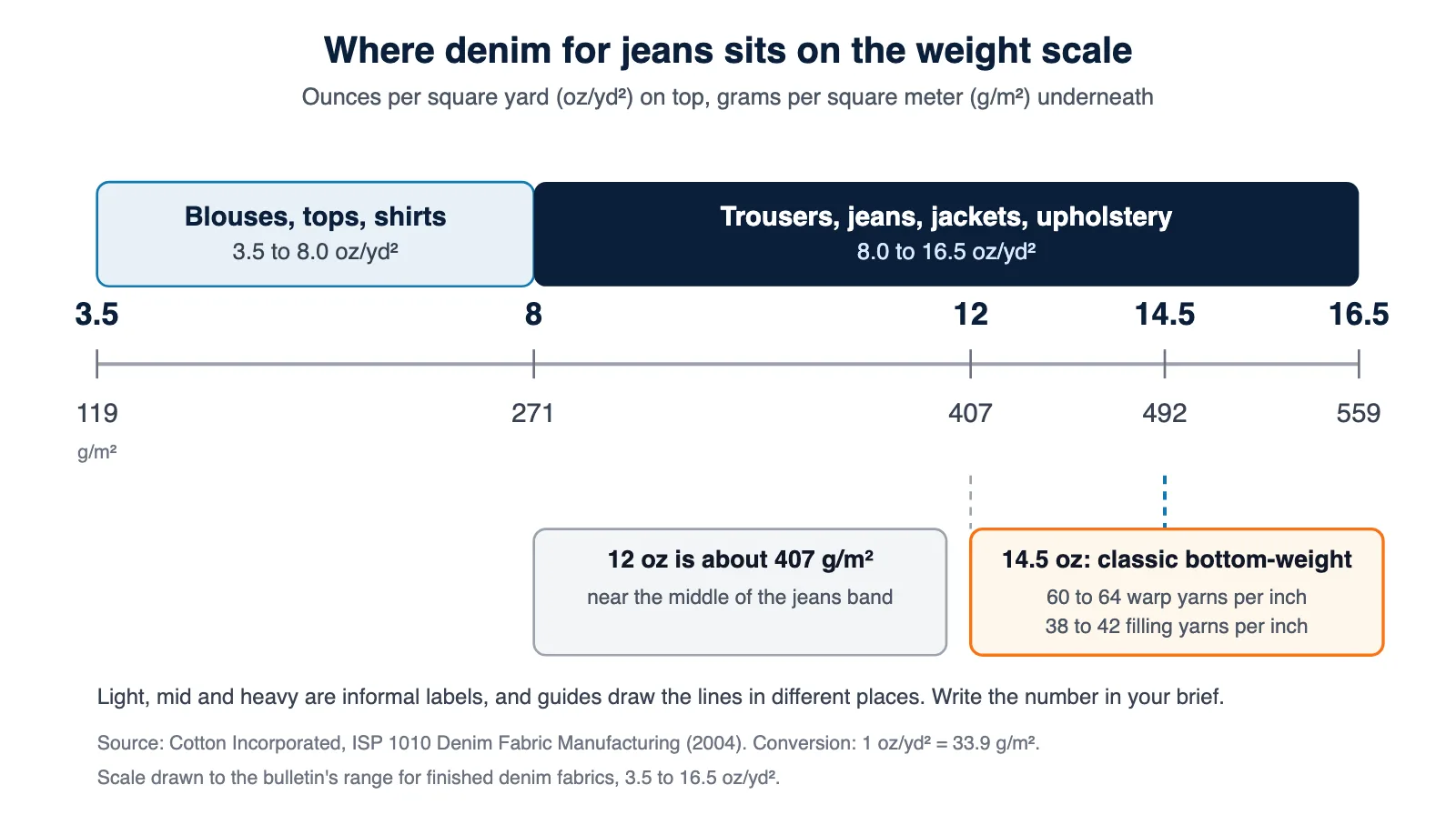
Inside the jeans band, buyers talk about light, mid and heavy denim, but the labels are informal. Guides draw the lines at different weights, so one guide's mid can be another's heavy. In a brief, write the number.
The table gives a direction for each product. Treat it as a starting point that the sample confirms, since climate, market and fit all pull on the choice.
| Product | Where to start | What to check on the swatch |
|---|---|---|
| Denim shirts | At or just above the shirt band, which ends at 8.0 oz/yd² | How the cloth hangs and folds at the collar and cuffs |
| Jeans for warm weather | Lower part of the jeans band | How the fabric feels after your wash, not before it |
| Core all-season jeans | Middle of the band | Whether knees and seat keep their shape after the wash sample |
| Raw, heritage or workwear jeans | Upper part of the band, around the 14.5 oz benchmark and above | How the cloth breaks in, and how the thick seams at hems, belt loops and pockets lie |
| Denim jackets | The same band as jeans | How the fabric drapes at the shoulders and how it looks in the wash you chose |
Is the weight on the spec raw or finished?
Ask the mill, because the number can describe fabric at different points in its life. One figure is the fabric as it comes off the loom. Another is the same fabric after finishing, and a third is the fabric in your jeans after your own wash.
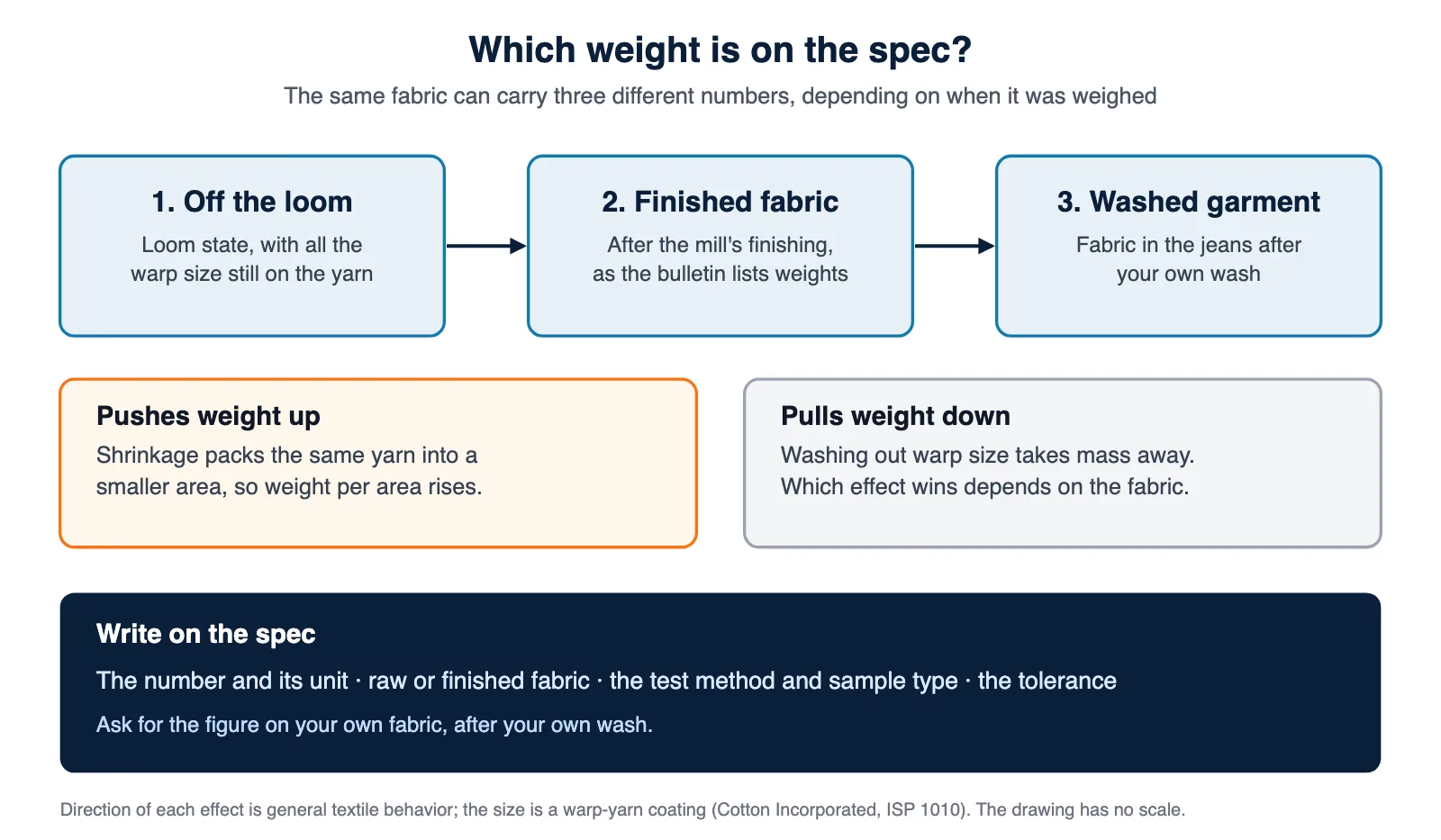
Two effects move the weight in opposite directions. Shrinkage packs the same yarn into a smaller area, which raises the weight per area. Washing out warp size takes mass away. The bulletin notes that mills choose the type and amount of size to suit the fabric and garment finishing that follows, so the balance depends on the mill's recipe and on your wash. The figure to trust is the factory's measurement of your own fabric after your own wash.
The test matters too. ASTM D3776 has separate options for a full piece or roll, a full-width sample and a small swatch, and it says a small-swatch result applies to that swatch and not necessarily to the whole lot. A hanger card that says 12 oz therefore describes one cut of cloth. Ask which option produced the number, and which plus or minus percentage the mill guarantees on bulk.
Write the weight as a number with its unit, say whether it describes raw or finished fabric, and name the test method.
An entry in the fabric row of a tech pack can look like this:
| Field | Example entry |
|---|---|
| Weight | 12 oz/yd² (407 g/m²), finished fabric |
| Test method | ASTM D3776, full-width sample |
| Tolerance | The plus or minus percentage the mill guarantees, in writing |
| Composition | Percent by fiber, as printed on the mill sheet |
| Stretch | A percentage, with the test method named, for example ASTM D3107 |
Our guide to the jeans tech pack shows where this row sits on the page and how the size basis, the wash standard and the measurement chart fit around it.
Does stretch change the weight you should order?
Weight and stretch are separate columns on a mill sheet. A 12 oz fabric can be rigid cotton or a stretch blend, so the weight does not tell you how the jeans will fit.
One common way to make stretch denim is core-spun yarn, where cotton fibers wrap around a spandex filament, as the same Cotton Incorporated bulletin describes. Its Natural Stretch brochure charts stretch against fabric weight for plain weave and twill fabrics, with stretch tested to ASTM D3107. The practical point for a brand is to take the stretch percentage from the exact fabric at the exact weight you are buying, and not from a similar one.
Fit follows from that choice. Skinny styles usually take a higher stretch, while mom and wide-leg styles usually work in rigid or low-stretch denim, as our women's jeans page explains. A high-stretch fabric is cut with less ease than a rigid one, which is why the fabric is settled before the pattern. Our guide to men's and women's jeans covers that side.
How to pick a weight for a first order
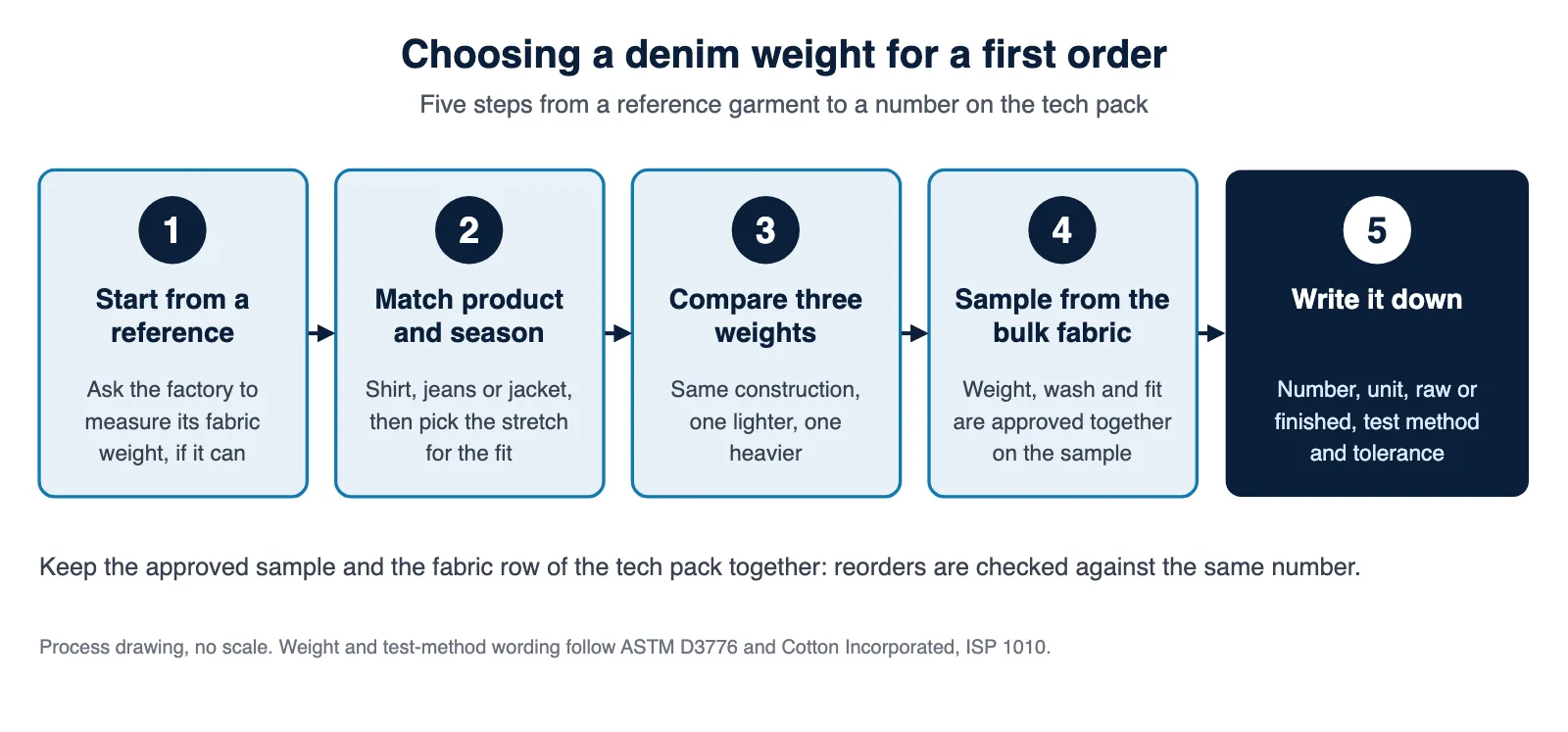
- Start from a reference. If you have a garment whose fabric you like, ask the factory whether it can measure that fabric's weight and report it as a finished figure.
- Match the weight to the product and the season using the table above, then set the stretch for the fit.
- Ask for the same construction one weight lighter and one heavier, as swatches or a swatch book, so weight is the only thing that changes between them.
- Cut the sample from the fabric you intend to bulk-order. Weight, wash and fit are approved together on the sample, so a different fabric in bulk changes all three.
- Write the final figure into the tech pack with its unit, the raw or finished state, the test method and the tolerance.
What to ask the mill or factory about weight
- Is the quoted weight loom state or finished, and in which unit?
- Which method produced it, and was it a swatch, a full-width sample or a roll?
- What tolerance does the mill guarantee on bulk, as a plus or minus percentage?
- How does the weight change after the wash I have chosen, measured on this fabric?
- What are the composition and the stretch percentage at this exact weight, and which test method gave the stretch?
- Can I see the same construction one weight lighter and one heavier?
- Does this fabric carry its own minimum order, and how long does it take to arrive?
- Which of my seams are the thickest at this weight, and how does the factory sew them?
At Kuzgunlar the fabric, including its weight and stretch, is sourced to your brief and fixed on the sample together with the wash. Send a reference garment, a swatch with its weight or the fabric row of your tech pack when you ask for a quote. The minimum order is 100 to 150 pieces per style, and some fabrics and washes have their own minimums. A sample takes 7 to 10 days once the brief is clear. See how private label jeans and production work, then send your brief.
For the wash that is approved alongside the fabric, see our guide to denim washing techniques. For the wider list of supplier questions, see how to choose a denim manufacturer.
Sources
- Cotton Incorporated, ISP 1010: Denim Fabric Manufacturing (2004)
- ASTM D3776/D3776M, Standard Test Methods for Mass Per Unit Area (Weight) of Fabric
- Cotton Incorporated, Natural Stretch brochure (2026)
Sources read on November 19, 2026. Conversions use 1 oz/yd² = 33.9 g/m² and are rounded to the nearest gram.
Frequently asked questions
Is 12 oz denim heavy?
How do I convert g/m² to oz/yd²?
Does heavier denim mean better quality?
Do I still need a weight if I send a reference garment?
How many weights should I ask swatches for?
Is there a minimum order for a specific denim weight?
Does stretch denim need a different weight from rigid denim?
Can the same weight work for men's and women's jeans?

0 comments
Leave a comment
Your comment will be published after review.