
Summarize this article with AI Open a summary of this article in your preferred assistant
Denim is traditionally made entirely of cotton, a natural fibre. Stretch denim can add a synthetic elastane core to the yarn, or get its stretch from the weave and stay 100% cotton. The composition line, with fibre names and percent by weight, shows which one you have.
Denim is traditionally made entirely of cotton, a natural fibre. Stretch denim can add a synthetic elastane core to the yarn, so the composition line, not the word denim, tells you which kind you have.
This guide is for brands ordering jeans, denim jackets or shirts from a factory, and for anyone checking a label. It covers what denim is made of, why some fabrics hold synthetic fibre, what US and EU rules require a composition line to say and what to write on your spec. The fibre descriptions and label rules come from the US Textile Rules, EU Regulation 1007/2011 and Cotton Incorporated.
What is denim made of?
Denim is a cotton twill fabric. Cotton Incorporated's bulletin ISP 1010 says denim is woven as 3/1 twill, 2/1 twill, 3/1 broken twill or 2/2 broken twill, and that in most denim the warp yarns are dyed with indigo while the filling yarns are left undyed.
The yarns are cotton. The Wikipedia article on denim states that traditional denim yarn is composed entirely of cotton. Jeans cut from traditional denim are therefore cotton, not synthetic.
Why do some jeans contain synthetic fibre?
Mostly for stretch. ISP 1010 describes elastic denim yarns: a spandex filament is fed in at the back of the front drafting roll of a ring-spinning machine, and the drafted cotton fibres twist around the spandex core. The yarn has cotton on the outside and an elastic core. A study of core-spun denim in the journal Heliyon reports that a core-spun yarn with spandex in the centre enhances the fabric's stretch capacity.
Stretch does not have to come from a synthetic fibre. Cotton Incorporated's Natural Stretch brochure describes a mechanical stretch construction for 100% cotton fabric. The fabric is woven about 25 percent wider at the loom and then allowed to shrink in width during slack mercerization, which leaves a crimp in the weft yarns. The brochure gives typical fill stretch of 10 to 18 percent, depending on fabric weight and weave, with no elastomeric yarns required.
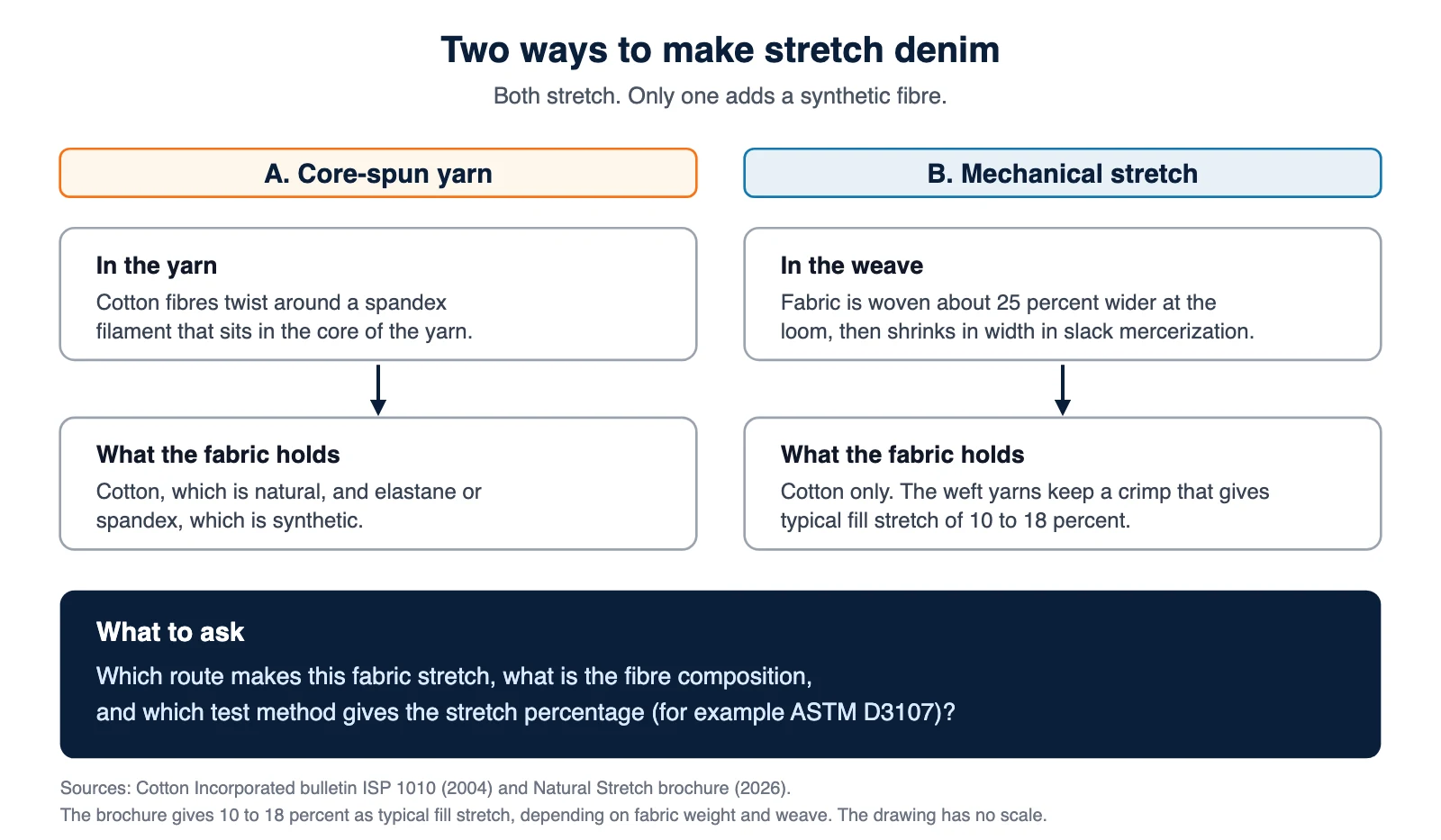
A stretchy pair of jeans can therefore be 100 percent cotton or a cotton and elastane blend, and the stretch alone does not tell you which. The composition line on the mill sheet does. Our guide to denim weight for jeans covers how stretch sits next to weight, and the guide to men's and women's jeans covers how it changes the pattern.
Which fibres count as natural, synthetic or regenerated?
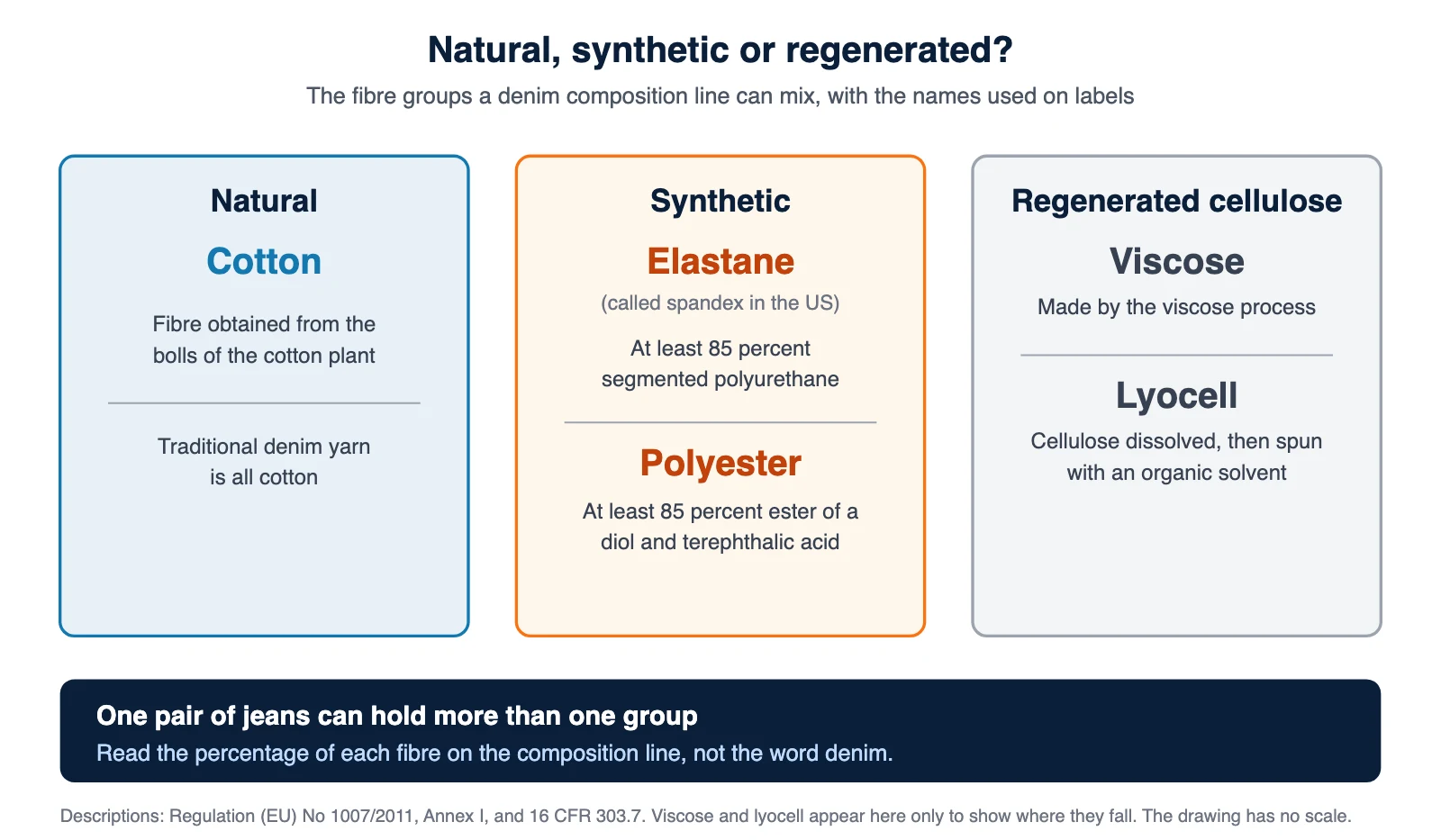
Cotton is natural, elastane and polyester are synthetic, and viscose and lyocell form a third group, regenerated cellulose. A composition line can mix them, and the EU and US fibre lists describe each fibre as follows.
| Fibre | Group | How the official lists describe it |
|---|---|---|
| Cotton | Natural | EU: fibre obtained from the bolls of the cotton plant. |
| Elastane (spandex in the US) | Synthetic | EU: an elastofibre of at least 85 percent segmented polyurethane by mass, which recovers rapidly after being stretched to three times its length. US: spandex is a long chain synthetic polymer with at least 85 percent segmented polyurethane. |
| Polyester | Synthetic | EU: a fibre of linear macromolecules with at least 85 percent by mass of an ester of a diol and terephthalic acid in the chain. |
| Viscose, lyocell | Regenerated cellulose | EU: viscose is a regenerated cellulose fibre obtained by the viscose process. Lyocell is a regenerated cellulose fibre obtained by dissolution and an organic solvent spinning process. |
Whether a pair of jeans is synthetic therefore has a percentage answer. The elastane or polyester share is synthetic, the cotton share is natural, and the split is printed on the composition line.
What must the composition line say in the US and the EU?
A garment sold in either market has to state its fibres, and the two systems differ on small shares, "100%" claims and language. The FTC's plain-language guide to the Textile and Wool Acts covers the US side.
| Point | US, 16 CFR Part 303 | EU, Regulation (EU) No 1007/2011 |
|---|---|---|
| Fibres listed | Generic names and percentages by weight, in order of predominance (303.16). | Name and percentage by weight of all constituent fibres, in descending order (Article 9). |
| Small shares | A fibre under 5 percent is called "other fiber", unless it has a definite functional significance, as in the rule's own example of 4 percent spandex (303.3). | "Other fibres" may stand in for a fibre up to 5 percent, or for fibres together up to 15 percent, only where they cannot easily be stated at the time of manufacture (Article 9). |
| "100%" or "all" | Only where the product or part is wholly one fibre (303.27). | Only for products exclusively composed of the same fibre. Up to 2 percent of extraneous fibres is accepted if technically unavoidable and not added as a matter of routine (Article 7). |
| Tolerance | A deviation of up to 3 percent of total fibre weight is not misbranding, so a stated 40 percent can run from 37 to 43. It does not apply to a one-fibre claim (303.43). | A manufacturing tolerance of 3 percent between the stated composition and the analysed percentages (Article 20). |
| Language | English (303.4). | The official language or languages of the Member State where the product is made available to the consumer, unless that state provides otherwise (Article 16). |
| Business to business | An invoice or other document may replace the label when the product is not in the form intended for the ultimate consumer (303.31). | Commercial documents may replace or supplement the label when products are supplied within the supply chain (Article 14). |
In the EU the manufacturer ensures the label is supplied and accurate, and the importer does so when the manufacturer is not established in the Union. A distributor that places a product on the market under its own name or trademark is treated as a manufacturer (Article 15). In the US, a person who directs a processor to label a product answers for what that label says or leaves out (303.2). A brand that sells private label jeans under its own name should expect to answer for the composition line and check it itself. EU market surveillance authorities check fibre composition against the information supplied (Article 18).
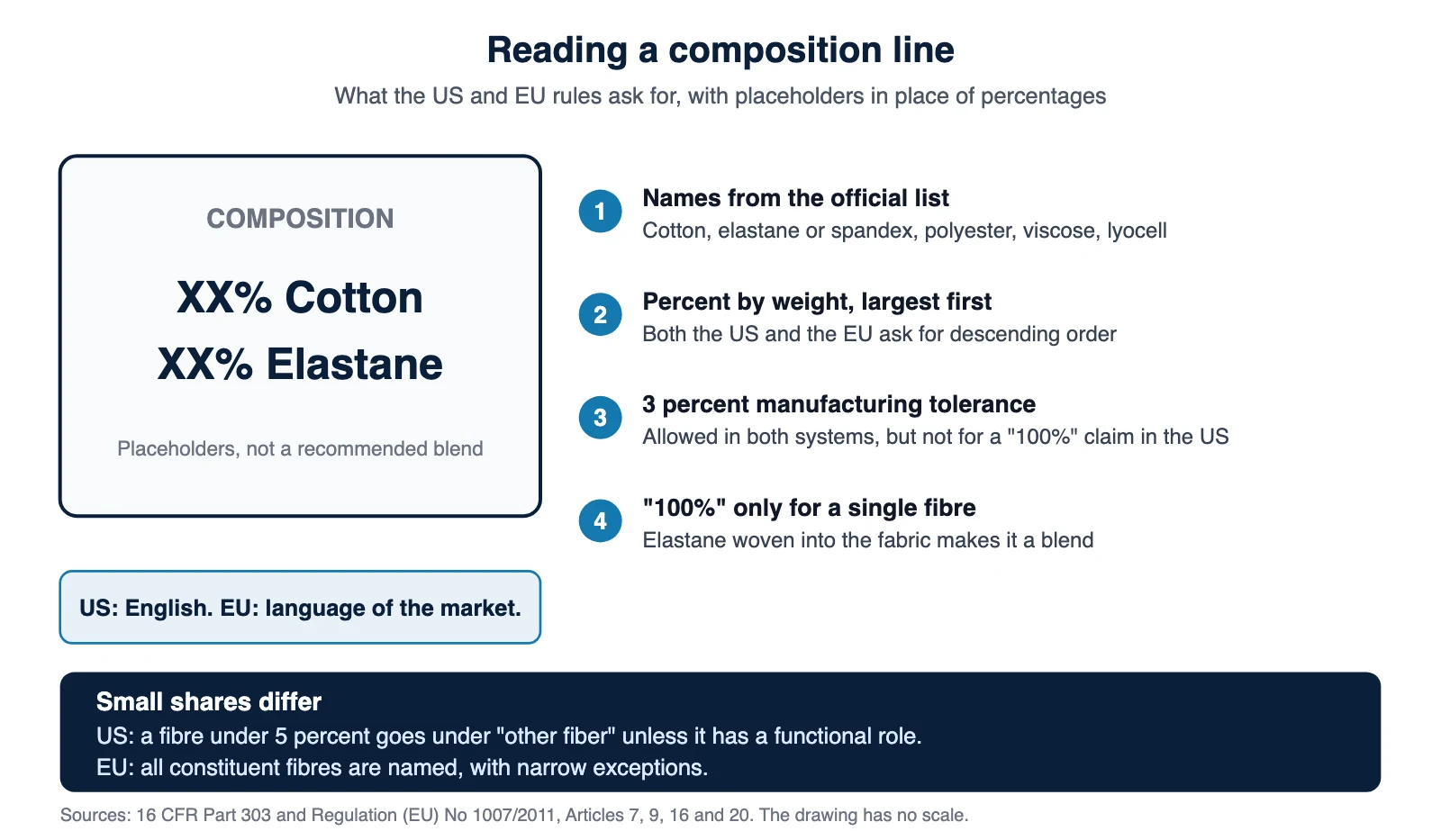
Write the composition from the mill sheet, with fibre names from the official list and percent by weight in descending order, and ask for a test report on the bulk fabric before labels are printed.
These are the general rules, and exceptions apply to some products, so your compliance team confirms which ones apply to your range. Label languages and the extra details buyers in each EU country ask for are covered in our guide to producing jeans in Turkey for EU brands.
What to write on the spec and ask the mill
Put the answers in the fabric row of the tech pack, so the label, the invoice and the sample all say the same thing. Our guide to the jeans tech pack shows where that row sits.
- Fibre names as the official lists spell them: cotton, elastane or spandex (US labels may use either), polyester, viscose, lyocell.
- Percent by weight for each fibre, in descending order, taken from the mill sheet and confirmed on the bulk fabric.
- How the stretch is made: core-spun yarn with elastane, or mechanical stretch in 100% cotton.
- The stretch percentage and the test method behind it, for example ASTM D3107, taken at the weight you are buying.
- The label language for each market you sell in.
- Any organic or recycled claim, with the documents behind it.
Do organic or recycled options change the answer?
Not the fibre group. Organic and recycled describe how a fibre was grown or sourced, so the composition line still uses the fibre name: cotton for cotton, polyester for polyester. The claim needs its own paperwork.
In the US, the FTC's Green Guides on recycled content say an unqualified claim fits only a product made entirely from recycled material, leaving out minor, incidental components. If only part is recycled, the claim should state the amount by weight. Check any recycled percentage against the supplier's documents before it goes on a label or a hangtag. Our guide to sustainable denim production costs covers the pricing side.
At Kuzgunlar the fabric, including its composition and stretch, is sourced to your brief and approved on the sample together with the wash. Certified organic and recycled options are available; see our certificates. Send a reference garment, the fabric row of your tech pack or the composition you are aiming for when you ask for a quote. The minimum order is 100 to 150 pieces per style, and some fabrics and washes have their own minimums. A sample takes 7 to 10 days once the brief is clear, and bulk production takes 3 to 5 weeks. See how private label jeans and production work, then send your brief.
For the wider list of supplier questions, see how to choose a denim manufacturer.
Sources
- Cotton Incorporated, ISP 1010: Denim Fabric Manufacturing (2004)
- Cotton Incorporated, Natural Stretch brochure (2026)
- 16 CFR Part 303, Rules and Regulations Under the Textile Fiber Products Identification Act (sections 303.2, 303.3, 303.4, 303.7, 303.16, 303.27, 303.31 and 303.43)
- FTC, Threading Your Way Through the Labeling Requirements Under the Textile and Wool Acts
- Regulation (EU) No 1007/2011 on textile fibre names and related labelling (Articles 5, 7, 9, 14, 15, 16, 18 and 20, and Annex I)
- 16 CFR 260.13, Recycled content claims
- Hossain et al., Effect of core material draft ratio and denier on core spun yarn and denim fabric properties pre and post washing, Heliyon 10(3), e24965 (2024)
- Wikipedia, Denim
Sources read on November 23, 2026.
Frequently asked questions
Is stretch denim synthetic?
Can denim stretch and still be 100% cotton?
Can jeans with elastane be labelled 100% cotton?
Are viscose and lyocell natural or synthetic?
In which language does the composition have to be written?
How far can the real composition differ from the label?
Who answers for the composition line, the factory or the brand?
Is organic or recycled cotton still cotton on the label?
0 comments
Leave a comment
Your comment will be published after review.