
Summarize this article with AI Open a summary of this article in your preferred assistant
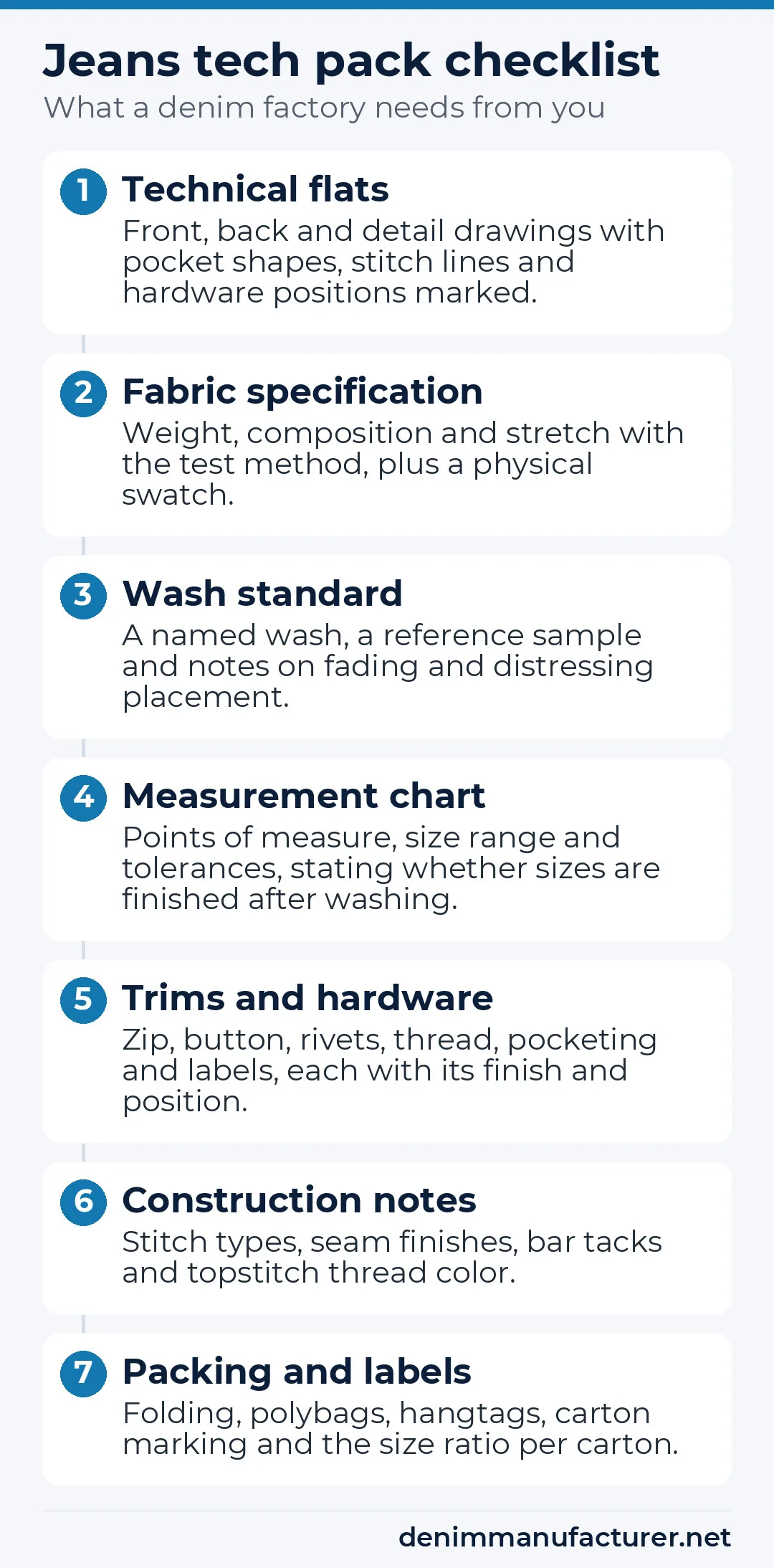
A jeans tech pack needs flat drawings, a fabric spec with weight and stretch, a measurement chart stating whether sizes are finished after washing, a named wash standard with a reference, exact trims and hardware, stitching notes and packing instructions. Version every page and say which document wins.
A jeans tech pack is the document a factory builds your jeans from: flat drawings, a fabric spec, measurements, a wash standard, hardware, stitching and packing notes in one place. For denim, the decisions that matter most are fabric weight and stretch, whether sizes are measured before or after washing, and a physical wash reference.
Jeans tech pack template: what to fill in on each page
Copy this table into a spreadsheet and fill in one row per page. The sections after it cover each row.
| Page | Fields to fill in | How to enter it |
|---|---|---|
| Cover sheet | Style name and code, season, brand, base size, size range, quantity per style, version and date | One code per style. The same version number and date go on every page. |
| Flat drawings | Front, back, side and close-up views, with every rivet, button and stitch line marked | One drawing per view. Part names must match the measurement chart and the trim list. |
| Fabric | Weight, composition, stretch, usable width, shade and base, swatch | Weight in oz/yd² or g/m² from the mill sheet, one unit only. Composition in percent as the supplier prints it. Stretch as a percentage with the test method named. |
| Wash standard | Wash name, reference sample or daylight photos, fade, whisker and distress locations | The name plus a physical reference. Mark each zone on the flat. |
| Size basis | Finished size after washing, or cut size before washing | One sentence at the top of the chart. For pre-wash sizes, add the shrinkage figure the factory has agreed to. |
| Measurement chart | Point code and name, where to measure from and to, base-size value, tolerance, grade rule | All values in one unit, with each tolerance as plus or minus in that unit. |
| Trims and hardware | Zip, button, rivets, thread, pocketing, patches | Size, finish, engraving and position for each. Add the supplier reference or color code, or write "match sample" and send the sample. |
| Construction | Stitch type per seam, stitch density, topstitch color, bar tacks, seam finishes | Write "standard construction except" and list your differences. |
| Labels and tags | Main label, size label, care and content labels, hangtags, stickers | Text, material and position for each. Wording follows the rules of the market you sell in. |
| Packing | Folding, polybag or hanger, carton marking, pieces per carton, size ratio, barcode positions | One line per instruction. Give the size ratio as pieces per size. |
| Approvals and changes | Which document wins, sample comments, version log | One line saying whether the pack or the reference garment wins. Issue a new version after every round of comments. |
What makes a jeans tech pack different
A general apparel template already covers flats, a bill of materials, measurements and packing. Jeans need four more decisions on top of that.
- Which size you are specifying: the cut piece or the finished jeans after washing.
- How the fabric behaves: its weight, how far it stretches and how much it shrinks.
- What the wash looks like, shown with a reference and not by name alone.
- Which hardware goes where, down to the finish of each rivet.
Our guide to the jeans production process explains why washing comes after sewing, which is why size and color change after the last seam.
Flat drawings that show every seam and hardware position
Draw the front, the back and any side view as flat technical sketches, not fashion illustrations. Mark the pocket shapes, yoke seams, fly and belt loops, and the position of every rivet and button.
Add close-ups for anything a photo could misread, such as the back pocket arc or the end of the waistband.
Give each part one name and keep it across the flats, the measurement chart and the trim list. If the flat says "coin pocket", the bill of materials should not call the same part something else.
Fabric specification: weight, stretch and a swatch
Describe the fabric by what it does and attach a physical swatch when you have one. If you ask the factory to source fabric to your brief, this specification is what it matches against.
- Weight: ounces per square yard (oz/yd²) or grams per square meter (g/m²). Pick one unit and keep it everywhere. ASTM D3776, the test method for fabric mass per unit area, treats SI and inch-pound values as separate standards, so mixing them in one document invites disagreement.
- Composition: fiber content in percent as printed on the fabric supplier's sheet, including any spandex or elastane.
- Stretch: rigid or stretch, and for stretch denim the amount as a percentage with the test method named. Cotton Incorporated reports stretch figures to ASTM D3107 and says they depend on fabric weight and weave, so a figure without a method is hard to compare.
- Shade and base: the dyed color, and whether you start from raw or already washed fabric.
- Width: usable width between the selvedges, because it changes how many garments one yard of fabric yields.
For how custom production works and what drives its cost, see our guide to custom denim jeans production in Turkey.
Shrinkage and finished size
Denim changes size when it is washed. Cotton Incorporated's 2004 guide to cotton shrinkage defines shrinkage as a dimensional change in length and width. In a garment, it adds, the change also shows up as seam puckering, twisting and a different fit.
Length and width often move by different amounts, so one shrinkage number rarely describes the whole garment. State your basis on the first page of the measurement chart:
Write every measurement as a finished size after washing, and say so at the top of the chart.
Pre-wash sizes also work, but only if the pack carries the shrinkage figure and the factory has agreed to it. A factory will usually work out its cutting allowance from tests on your actual fabric and wash, so ask how it tests before you fix a number.
The Cotton Incorporated guide warns that some shrinkage specifications may not be attainable at all. It also describes AATCC Test Method 135 as a reliable way to relax cotton fabric before measuring it. Name it in the pack if you want results reported to a standard method.
Leg twist, where a side seam spirals around the leg after washing, is worth checking on the first wash sample. Write down how much you will accept.
Measurement chart for a five-pocket jeans
Give every point of measure a code, a name and a description of where it starts and stops. Delogue's guide to points of measure does the same, and keeps extra detail on a separate how-to-measure page. For jeans, the points below cover most of what a sample is checked against.
| Point | What to define |
|---|---|
| Waist | Where it is taken (top edge of the waistband, button fastened) and whether the figure is half or full circumference |
| Hip or seat | Distance below the top of the waistband, and half or full circumference |
| Front rise and back rise | Whether the waistband is included, and the seam each one is measured to |
| Thigh | Distance below the crotch seam |
| Knee | Distance below the crotch seam, or up from the hem |
| Leg opening | Measured flat across the finished hem |
| Inseam | Crotch seam to hem, and whether stretch denim is measured relaxed |
| Waistband and belt loops | Finished waistband height, plus loop count, length, width and placement |
| Fly and zip | Fly opening length and zip length |
| Front and back pockets | Opening size, depth where relevant, and placement from the yoke and side seams |
Add a tolerance to each point, written as plus or minus in the same unit. Delogue notes that sampling tolerances are usually stricter than production tolerances and that the manufacturer has to accept the ones you propose, so review them together before the first sample.
Name the base size and the grade rule for every point, so each size steps up in proportion. Fit and pattern differences between the two ranges are covered in our guide to men's and women's jeans.
Wash standard: describing color and fade
A wash name such as rinse, stone, enzyme or laser finishing names the method. It does not fix the final color and fade, so attach a reference: a washed garment or swatch, or photographs taken in even daylight. Mark on the flat where fading, whiskering and distressing sit.
At Kuzgunlar every batch is matched to the approved wash standard, so the reference you approve is the one bulk production is compared with. For the vocabulary, see our guides to denim washing techniques and what a rinse wash means.
Trims, hardware and labels
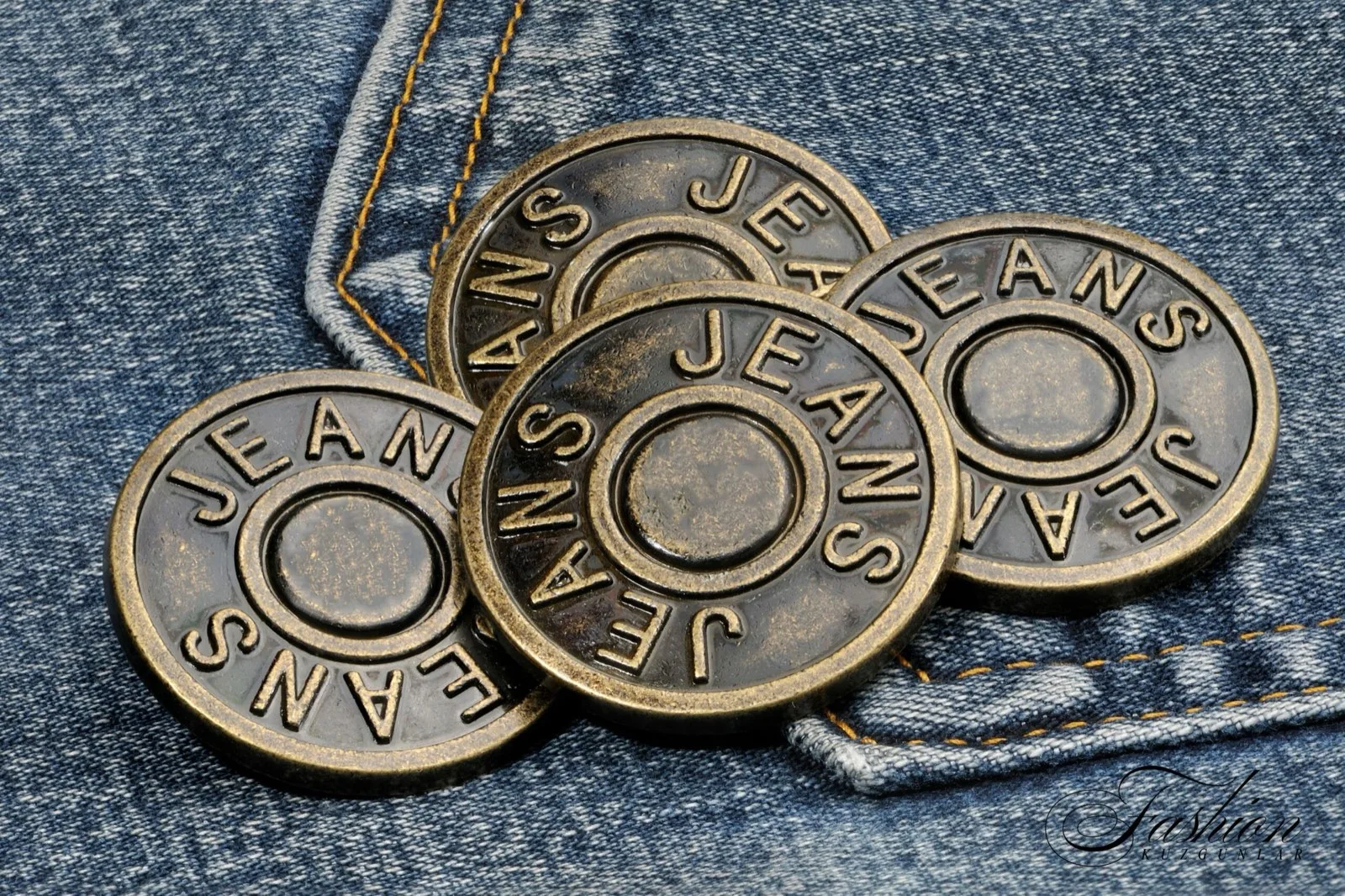
A bill of materials only works for jeans when every item is exact. "Metal button" leaves the factory to guess the size, finish and engraving.
| Item | What to give |
|---|---|
| Zip | Length, type, tape color, metal finish and puller style |
| Button | Size, finish, engraving and how it is attached |
| Rivets | Size, finish, engraving, number and positions |
| Thread | Type and weight, with colors for the body, topstitching and bar tacks |
| Pocketing | Fabric, color and whether it is plain or printed |
| Labels and patches | Main label, size and care labels, patch material, and the position of each |
| Hangtags and stickers | Text, material and attachment point |
Where you have a supplier reference or color code, write it down. Where you do not, say "match sample" and send the sample.
Care and content labels follow the rules of the market you sell in; our guide to producing jeans in Turkey for EU brands covers labels, customs and buyer requests.
Stitching and construction notes
List the stitch type for each major seam, the stitch density and the topstitch thread color. Say how the fly, waistband join, belt loops and pocket corners are reinforced, for example with bar tacks, and which seam finish you want on the inseam and side seam.
A factory already has a standard construction for a five-pocket jean. Write "standard construction except" and list your differences, then sketch any detail that is unusual.
Packing instructions
Specify the folding method, polybag or hanger, hangtag position and carton marking. Add the number of pieces per carton and the size ratio, plus barcode or sticker positions if your retailer requires them. These lines take minutes to write now and are slow to fix once cartons are closed.
Keeping the pack and the sample in agreement
Put a version number and a date on every page. When a sample comes back with comments, update the pack and issue a new version, so the next sample is built from the document you judge it against.
Add one line saying which one wins if the pack and the reference garment disagree. Without it, the factory has to guess and the comments take another round.
The version matters later as well. At Kuzgunlar, measurements are checked against your size chart during production, so a chart with the finished-size basis written on it is the one that gets checked. Our guide to choosing a denim manufacturer lists the sampling and quality questions to ask any factory.
What to send when you ask Kuzgunlar for a quote
Kuzgunlar quotes from a tech pack, a sketch or a reference garment. Send it with the quantity per style and the size split, your fabric and wash preference, the trims and labels you want, and your target date and destination.
A complete pack is not required to start: a sketch with the key measurements and a reference garment is enough to open the conversation. Minimum orders are 100–150 pieces per style, and one order can mix styles.
A sample takes 7–10 days once the brief is clear, so the more complete your pack, the sooner sampling can start. See how private label jeans and production work, then send your brief.
Sources
Frequently asked questions
Do I need a finished tech pack before asking for a quote?
Should I give jeans measurements before or after washing?
What file format should a tech pack use?
Can one tech pack cover men's and women's jeans?
How do I describe a wash if I only have photos?
Who sets the shrinkage allowance, the brand or the factory?
What should I do when the sample does not match the tech pack?
What is a tech pack in clothing, and is a jeans pack different?
How much does a jeans tech pack cost?
Should the tech pack list testing or labeling requirements?

0 comments
Leave a comment
Your comment will be published after review.