
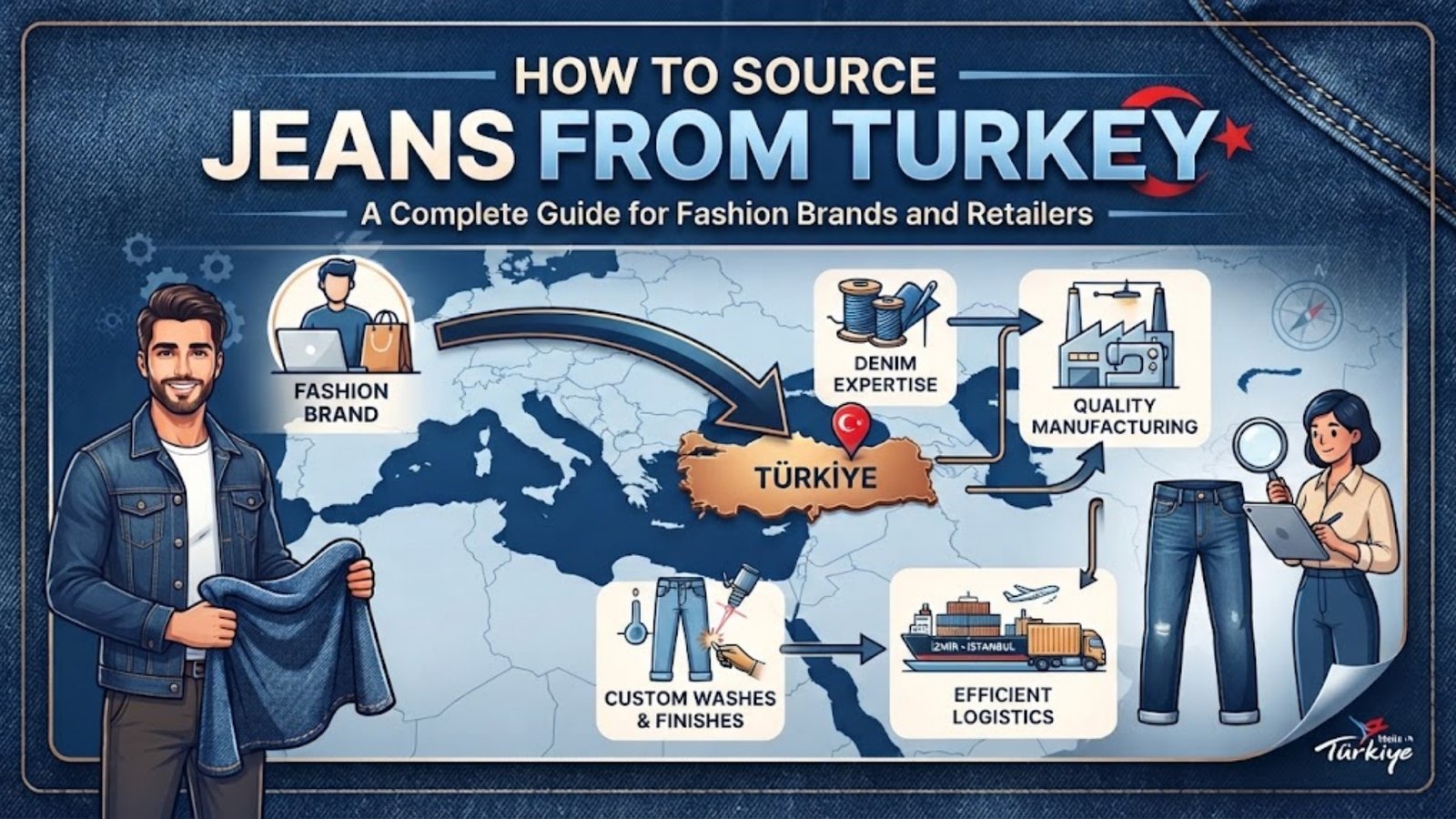
Sourcing jeans from Turkey can give fashion brands access to an established denim manufacturing ecosystem, experienced garment production and a supply base positioned close to European markets. However, successful sourcing depends on more than finding a factory and requesting a price.
Brands need to evaluate suppliers, define product specifications, develop samples, confirm fabric and wash requirements, establish quality-control procedures, understand MOQ, plan production lead times and coordinate export documentation before placing a bulk order.
For international fashion companies sourcing jeans, denim jackets, denim shirts or private label collections, Turkey can be considered as part of a broader sourcing strategy. The right approach is to evaluate the complete supply chain from product development through shipment rather than focusing only on the factory quotation.
Sourcing jeans from Turkey works best when the buyer treats manufacturing, product development, quality control, logistics and export as one connected process rather than separate purchasing decisions.
This guide explains how international fashion brands can source jeans from Turkey, what to evaluate before choosing a supplier and which production factors should be confirmed before a bulk order.
Why Do Fashion Brands Source Jeans from Turkey?
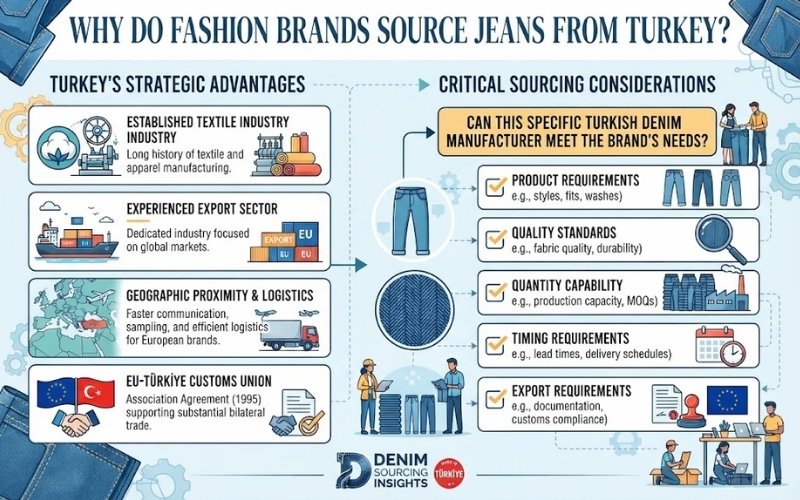
Turkey has a long-established textile and apparel manufacturing base and an experienced export-oriented garment industry. For brands serving European markets, its geographic position can also make supplier communication, sampling and logistics more practical.
The European Commission describes the EU–Türkiye relationship as being based on an Association Agreement and a Customs Union that entered into force in 1995. The Customs Union covers industrial goods and has supported substantial bilateral trade between the two markets. However, brands should still verify the applicable product classification, origin requirements and customs documentation for each shipment rather than assuming that every product receives identical treatment. EU Access2Markets provides the official framework for checking tariffs, taxes, import requirements and trade procedures.
For denim sourcing, Turkey’s value therefore comes from a combination of manufacturing capability, geographic proximity, export infrastructure and an established textile supply chain.
But country-level advantages do not automatically mean that every supplier is suitable for every fashion brand.
The more important question is:
Can this specific Turkish denim manufacturer meet the brand’s product, quality, quantity, timing and export requirements?
How Does Jeans Sourcing from Turkey Work?
International buyers should approach Turkish denim sourcing as a structured production workflow.
A typical sourcing process can include:
- Defining the product requirements
- Identifying suitable Turkish manufacturers
- Evaluating manufacturing capabilities
- Sending technical specifications or a tech pack
- Selecting fabrics and components
- Developing samples
- Approving fit and measurements
- Developing and approving the wash
- Confirming MOQ and commercial conditions
- Establishing quality-control requirements
- Planning bulk production
- Completing final inspection
- Preparing export documentation
- Shipping the finished garments
Each stage affects the next one. A vague product specification can create sampling revisions. An unsuitable fabric can affect the wash result. An unrealistic lead time can affect the launch date. Poor quality planning can create costly problems after production has already started.
For this reason, sourcing should be managed as a connected process rather than a simple quotation exercise.
1. Define What You Want to Source Before Contacting Manufacturers
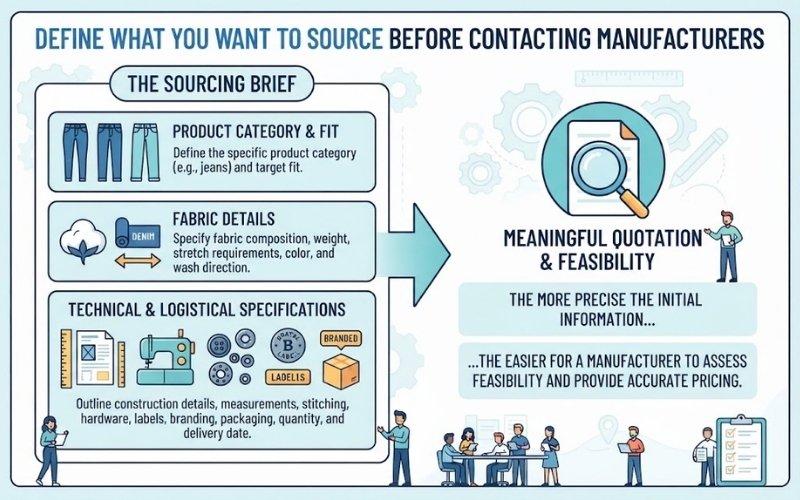
The first step is to define the product clearly enough for a manufacturer to evaluate it.
“We need jeans” is not sufficient information for an accurate sourcing discussion. A manufacturer needs to understand the product category, target fit, fabric expectations, construction details, wash appearance and expected quantity.
Depending on the collection, the initial sourcing brief may include:
- Product category
- Target fit
- Fabric composition
- Fabric weight
- Stretch requirement
- Color or wash direction
- Garment measurements
- Stitching requirements
- Hardware specifications
- Labels and branding
- Packaging requirements
- Target quantity
- Target delivery date
The more precise the initial information, the easier it becomes for a manufacturer to assess feasibility and provide a meaningful quotation.
Brands developing highly customized products should also prepare a technical package that explains construction and measurement requirements rather than relying only on reference photographs.
2. Find Denim Manufacturers Rather Than Generic Garment Suppliers
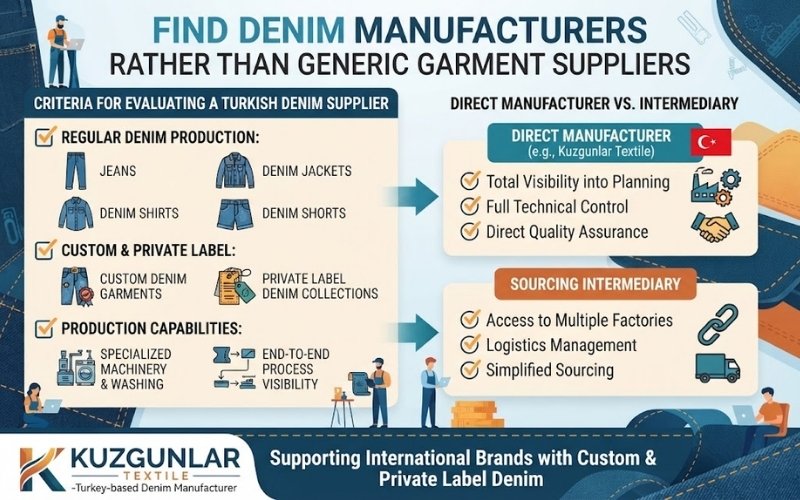
One of the most important sourcing decisions is identifying companies with genuine denim manufacturing experience.
Not every garment factory is equally equipped to produce jeans. Denim production involves specific construction requirements, specialized machinery, fabric handling, washing and finishing processes.
When evaluating a Turkish supplier, ask whether the company regularly produces:
- Jeans
- Denim jackets
- Denim shirts
- Denim shorts
- Custom denim garments
- Private label denim collections
Also determine which production stages are managed directly and which are handled through external partners.
A sourcing intermediary can sometimes provide access to several factories, but a direct manufacturer can offer a different level of visibility into production planning, technical development and quality control.
Kuzgunlar Textile operates as a Turkey-based denim manufacturer supporting international fashion brands with custom and private label denim production.
3. Evaluate the Manufacturer’s Production Structure
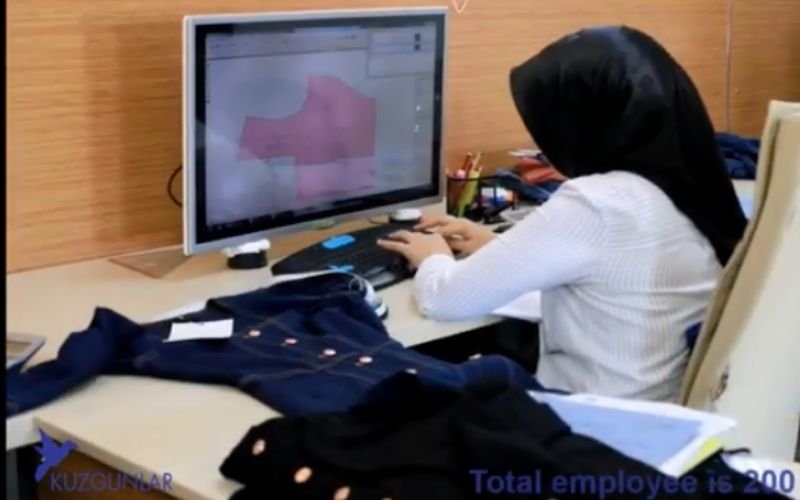
Once potential suppliers have been identified, brands should look beyond product photographs and request information about the actual production structure.
Important questions include:
- Where does product development take place?
- Where are patterns developed?
- How is fabric sourced and inspected?
- Where does cutting take place?
- How is sewing organized?
- Where are washing and finishing processes performed?
- How is quality controlled?
- Who prepares finished goods for shipment?
This information helps the buyer understand how many production interfaces exist between the initial order and the finished garment.
Fewer uncontrolled interfaces can make technical communication and production tracking easier, particularly for custom denim products.
4. Request Samples Before Placing a Bulk Order
Sampling is one of the most important stages of jeans sourcing because a technical specification does not always predict how the finished garment will look and fit.
A professional development process can involve several sample stages.
| Sample Stage | Purpose |
|---|---|
| Prototype | Checks the basic construction and interpretation of the product specification. |
| Fit Sample | Evaluates measurements, proportions and wearing fit. |
| Wash Sample | Evaluates the intended color, abrasion and visual appearance. |
| Revised Sample | Confirms corrections requested after technical review. |
| Pre-Production Sample | Provides the approved reference for bulk production. |
Brands should not assume that the first prototype represents the final production garment.
Fit, measurements, fabric behavior and washing can require revisions before approval.
This is particularly important for denim because fabric shrinkage and washing can affect final garment dimensions.
5. Select the Denim Fabric Carefully
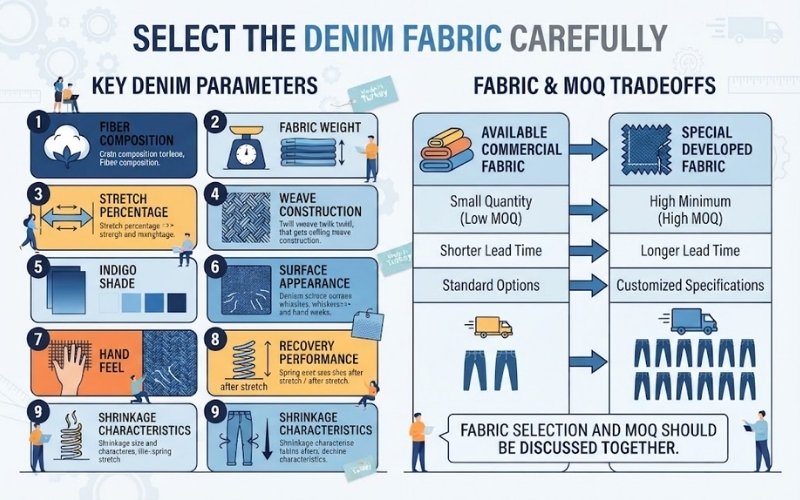
Fabric selection directly affects the fit, appearance, comfort, durability and washing result of jeans.
When sourcing from Turkey, brands should define whether they require rigid denim, comfort stretch denim, high-stretch fabric or another construction.
Important fabric parameters may include:
- Fiber composition
- Fabric weight
- Stretch percentage
- Weave construction
- Indigo shade
- Surface appearance
- Hand feel
- Recovery performance
- Shrinkage characteristics
Fabric availability can also affect MOQ and lead time. A supplier may be able to produce a small quantity using an available commercial fabric but require a higher minimum for a specially developed fabric.
Therefore, fabric selection and MOQ should be discussed together rather than treated as independent decisions.
6. Understand MOQ When Sourcing Jeans from Turkey
MOQ is one of the first commercial questions brands should clarify with a Turkish denim manufacturer.
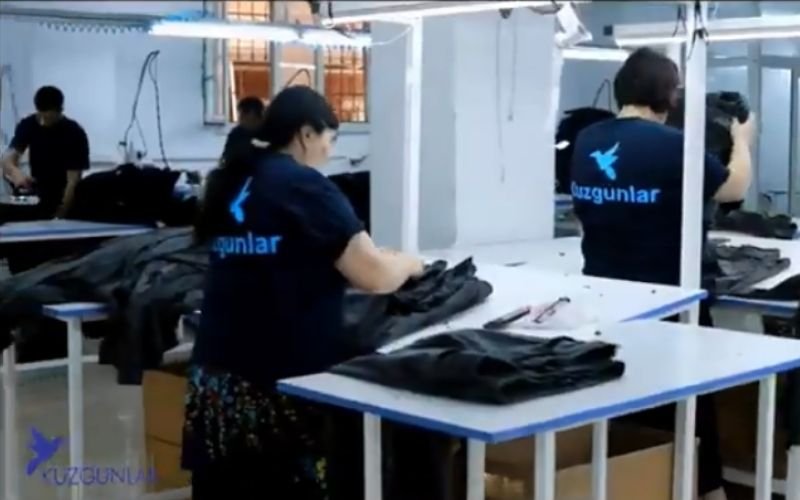
However, there is no universal MOQ that applies to every denim order.
The practical minimum may depend on:
- Number of styles
- Number of colors
- Fabric availability
- Custom fabric development
- Wash complexity
- Custom trims
- Label requirements
- Packaging specifications
- Production planning
- Repeat-order potential
A startup may therefore have a different sourcing model from an established fashion retailer.
Brands looking for smaller production quantities can review our guide to low MOQ jeans production in Turkey for a more detailed explanation of the factors affecting minimum order quantities.
7. Develop the Wash Before Bulk Production
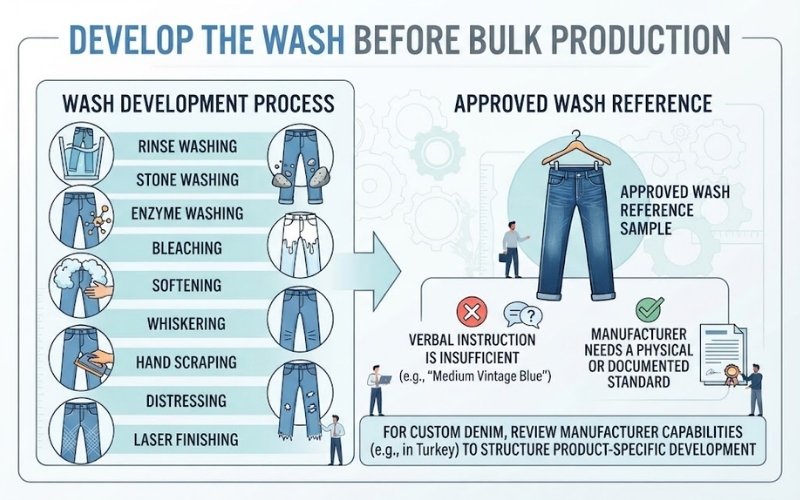
Denim washing can substantially change the appearance and dimensions of a garment.
Two garments made from similar fabric can produce very different results depending on washing, abrasion, softening and finishing treatments.
Depending on the product, development may involve:
- Rinse washing
- Stone washing
- Enzyme washing
- Bleaching
- Softening
- Whiskering
- Hand scraping
- Distressing
- Laser finishing
- Other specialized surface treatments
The buyer should approve a physical wash reference before bulk production.
A verbal instruction such as “medium vintage blue” is not sufficiently precise for repeatable production. The manufacturer should instead work from an approved sample or clearly documented development reference.
Brands requiring highly customized denim products can also review custom denim jeans manufacturing in Turkey to understand how product-specific development can be structured.
8. Confirm Quality Control Before Production Starts
Quality control should be defined before the bulk order begins.
International buyers should agree with the manufacturer on what constitutes an acceptable finished garment and which checkpoints will be used during production.
Relevant quality controls can include:
- Fabric inspection
- Shade control
- Measurement checks
- Cutting accuracy
- Seam construction
- Stitch density
- Hardware placement
- Wash consistency
- Garment appearance
- Final measurements
- Final inspection
For larger orders, buyers may also establish an AQL-based inspection procedure for finished lots.
AQL should not replace process-level quality control. It is a sampling approach used to evaluate a production lot under defined acceptance criteria.
Our detailed resource on AQL inspection in denim manufacturing explains how this approach can be incorporated into denim quality management.
9. Understand the Complete Jeans Production Process
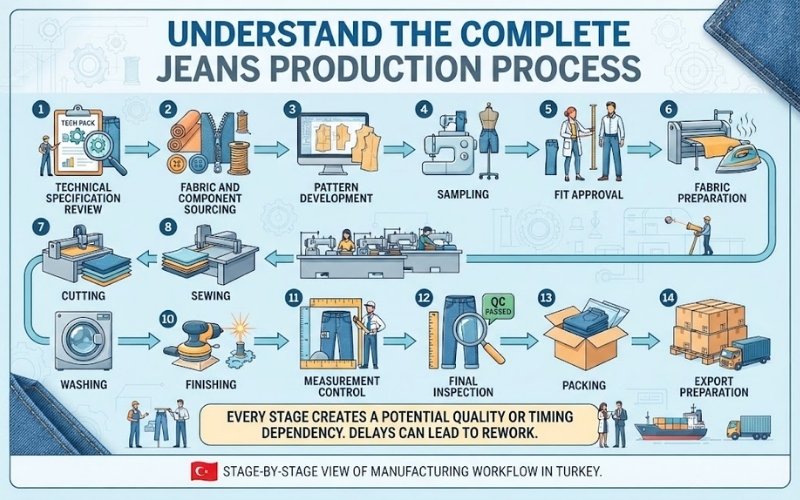
Before selecting a supplier, the buyer should understand how the jeans move from technical development to finished product.
A typical production sequence can include:
- Technical specification review
- Fabric and component sourcing
- Pattern development
- Sampling
- Fit approval
- Fabric preparation
- Cutting
- Sewing
- Washing
- Finishing
- Measurement control
- Final inspection
- Packing
- Export preparation
Every stage creates a potential quality or timing dependency.
For example, a delay in fabric availability can move the cutting schedule. A wash revision can delay final approval. A measurement problem identified late in production can create rework.
Brands can review our detailed explanation of the jeans production process in Turkey for a stage-by-stage view of the manufacturing workflow.
10. Compare Lead Times by Production Stage
One of the common sourcing mistakes is asking only, “How many weeks will production take?”
The actual sourcing calendar can contain several separate periods.
| Stage | What Can Affect the Timing? |
|---|---|
| Product Development | Number of styles, technical revisions and sample approvals. |
| Fabric Procurement | Stock availability and custom fabric requirements. |
| Wash Development | Number of wash revisions and approval requirements. |
| Bulk Production | Order quantity, production planning and capacity. |
| Final Inspection | Inspection method and correction requirements. |
| Export Preparation | Documentation, packing and logistics coordination. |
A realistic production schedule should therefore include development and approval stages rather than treating bulk sewing as the entire lead time.
11. Check Whether the Manufacturer Can Handle Export Requirements
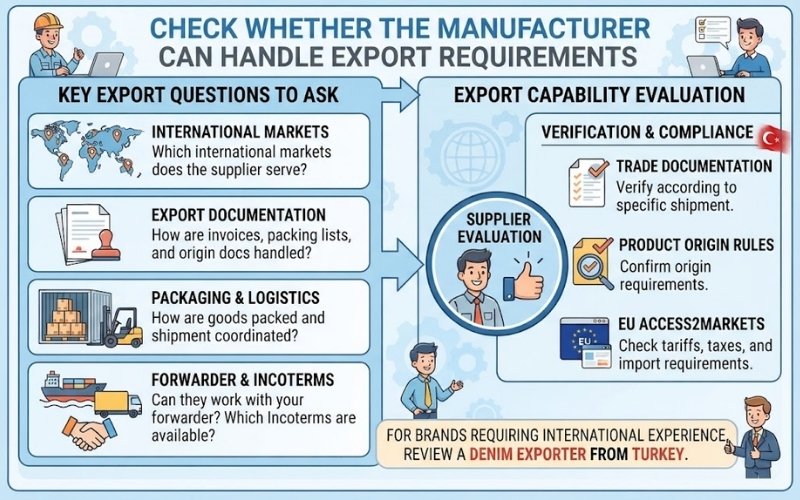
Sourcing jeans internationally involves more than manufacturing the garments.
The supplier must also be able to coordinate the operational requirements associated with international shipment.
Ask the manufacturer:
- Which international markets does it regularly serve?
- How are export documents prepared?
- How are goods packed for international shipment?
- How is the shipment coordinated?
- Can the supplier work with the buyer’s nominated forwarder?
- Which Incoterms are available?
- How are commercial invoices and packing lists handled?
- What origin documentation may be required?
For European buyers, trade documentation and product origin should be verified according to the specific shipment. The EU’s official Access2Markets platform provides product-specific information on tariffs, taxes and import requirements.
For brands that need a supplier with international shipment experience, our guide to a denim exporter from Turkey explains the relationship between manufacturing and export operations.
12. Calculate the Real Sourcing Cost, Not Just the Factory Price
A factory quotation is only one part of the total sourcing cost.
International buyers should consider the complete cost structure before comparing Turkish suppliers with manufacturers in other countries.
| Cost Component | Why It Matters |
|---|---|
| Garment Cost | Base manufacturing price. |
| Sampling | Development and prototype expenses. |
| Fabric | Can vary according to composition, weight and availability. |
| Custom Trims | Buttons, rivets, labels and branding components. |
| Washing | Depends on the required treatment and complexity. |
| Inspection | May include internal or third-party inspection. |
| Transport | Depends on destination, shipment method and volume. |
| Import Costs | Depend on destination country, product classification and applicable trade rules. |
This is why comparing manufacturers only by the lowest unit quotation can produce misleading conclusions.
The better question is whether the supplier provides the best combination of quality, production reliability, commercial flexibility and total sourcing cost.
13. Evaluate Communication During the Sourcing Stage
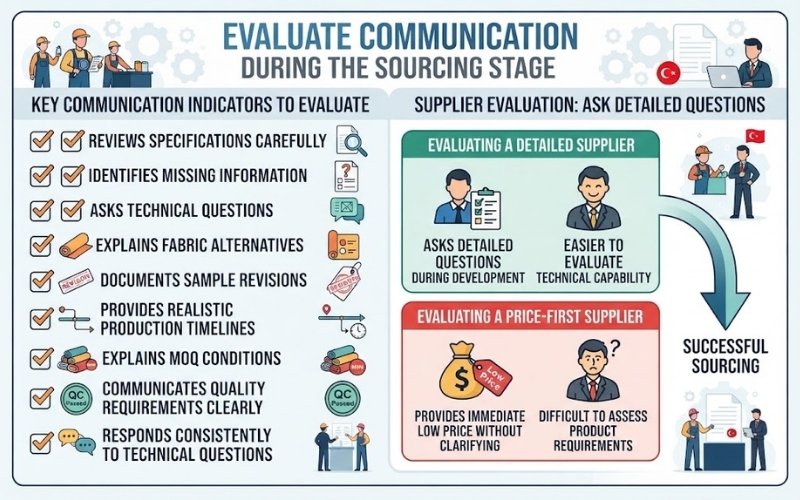
Communication should be evaluated before the first bulk order.
The sourcing stage itself provides useful information about how a manufacturer manages technical requirements.
Pay attention to whether the supplier:
- Reviews specifications carefully
- Identifies missing information
- Asks technical questions
- Explains fabric alternatives
- Documents sample revisions
- Provides realistic production timelines
- Explains MOQ conditions
- Communicates quality requirements clearly
- Responds consistently to technical questions
A supplier that asks detailed questions during development is often easier to evaluate than one that immediately provides a low price without clarifying the product requirements.
14. Check Whether the Supplier Can Scale with Your Brand
Sourcing decisions should consider future production rather than only the first order.
A brand may initially order a limited number of styles and later increase quantities if the collection performs well.
The manufacturer should therefore be evaluated for its ability to support:
- Repeat orders
- Additional styles
- Higher quantities
- New fits
- New washes
- Seasonal collections
- Private label development
Consistency becomes particularly important when successful products are reordered. Changing suppliers can introduce differences in fabric, fit, wash appearance and construction.
A long-term manufacturing relationship can therefore reduce development duplication and help maintain product consistency across collections.
15. What Should You Ask a Turkish Denim Manufacturer?
Before moving forward, brands should prepare a structured supplier questionnaire.
| Question | Why It Matters |
|---|---|
| Do you manufacture denim garments directly? | Clarifies the supplier’s production structure. |
| Which denim products do you produce? | Shows whether the manufacturer fits the product category. |
| What is your MOQ? | Determines commercial suitability. |
| Can you develop custom samples? | Important for private label collections. |
| Can you develop custom washes? | Determines denim finishing capability. |
| How do you control quality? | Shows how production risk is managed. |
| What is the estimated lead time? | Supports collection planning. |
| How are repeat orders handled? | Indicates long-term production capability. |
| Do you have export experience? | Helps assess international sourcing capability. |
| Which documents can you provide? | Supports international shipment planning. |
The answers should be compared across suppliers using the same criteria. This makes the sourcing process more objective than choosing a manufacturer based on price or a product gallery alone.
How to Compare Turkish Denim Manufacturers
A practical supplier comparison can use a weighted evaluation rather than a single price comparison.
| Evaluation Area | Suggested Consideration |
|---|---|
| Product Capability | Can the manufacturer produce the required denim categories and construction? |
| Development | Can it develop accurate samples and custom fits? |
| Fabric | Can it source or develop the required denim? |
| Washing | Can it reproduce the approved wash consistently? |
| MOQ | Does the quantity fit the brand’s business model? |
| Quality | Are quality controls defined throughout production? |
| Lead Time | Is the production calendar realistic? |
| Export | Can the supplier support international shipments? |
| Communication | Can technical information be exchanged accurately? |
| Scalability | Can the supplier support future collections and repeat orders? |
This approach makes it easier to identify the supplier that best matches the brand’s actual sourcing requirements.
Why Work with a Turkey-Based Denim Manufacturer?
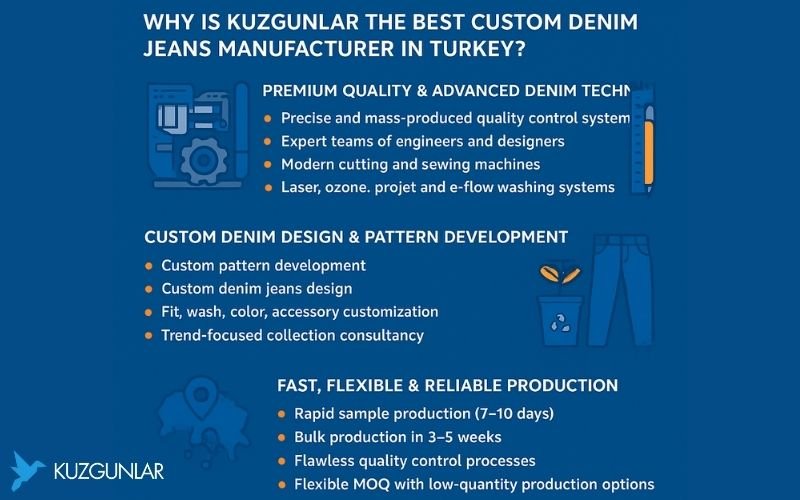
Turkey can be an attractive sourcing location for fashion brands that need a combination of manufacturing expertise, product development and access to European markets.
However, the decision should not be based on geography alone.
The value of sourcing from Turkey comes from finding a manufacturer that combines the relevant capabilities into a reliable production workflow.
For an international brand, that may include:
- Denim-specific manufacturing experience
- Custom product development
- Sampling and fit development
- Fabric sourcing
- Washing and finishing
- Quality control
- Private label production
- Export preparation
- Repeat-order support
The right combination depends on the brand’s collection, quantity, target market and product specifications.
Why Source Jeans from Kuzgunlar Textile?
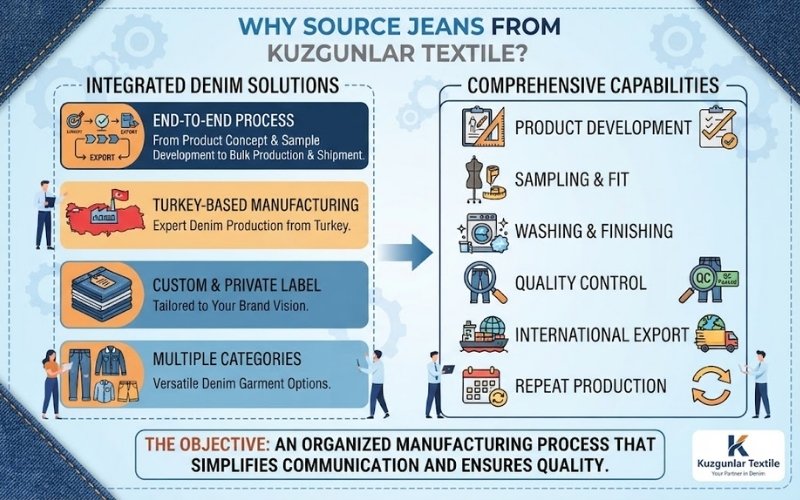
Kuzgunlar Textile is a Turkey-based denim manufacturer working with international fashion brands on jeans, denim jackets, denim shirts, shorts and custom denim products.
The company supports the production process across product development, sampling, manufacturing, washing, quality control and export preparation.
For brands evaluating Turkish suppliers, this integrated approach can simplify communication between product development and bulk manufacturing.
- Turkey-based denim manufacturing
- Custom denim product development
- Private label production
- Multiple denim garment categories
- Sampling and fit development
- Denim washing and finishing
- Quality-control processes
- International export support
- Repeat production capabilities
The objective is not simply to supply jeans but to provide an organized manufacturing process from product concept and sample development through bulk production and shipment.
How to Start Sourcing Jeans from Turkey
Brands interested in Turkish denim sourcing should begin with a clear product brief rather than a generic request for pricing.
The initial inquiry should ideally include the product type, reference images, measurements, fabric expectations, wash direction, target quantity and expected delivery period.
The manufacturer can then evaluate the project, identify technical requirements, discuss fabric and production options and establish a realistic development plan.
A practical sourcing sequence is:
- Prepare the product brief or tech pack.
- Identify suitable Turkish denim manufacturers.
- Share specifications and target quantities.
- Review manufacturing and fabric options.
- Develop the first samples.
- Complete fit and measurement revisions.
- Develop and approve the wash.
- Confirm MOQ and commercial terms.
- Approve the production reference.
- Agree on quality-control requirements.
- Schedule bulk production.
- Complete final inspection.
- Prepare export documentation.
- Ship the finished collection.
This process gives the buyer defined decision points before significant production quantities are committed.
Conclusion
Sourcing jeans from Turkey should be approached as a complete manufacturing and supply-chain decision rather than a simple search for the lowest factory price.
The strongest sourcing process starts with clear product specifications and continues through manufacturer evaluation, sampling, fabric selection, wash development, MOQ confirmation, quality control, production planning and export preparation.
Turkey can provide an established manufacturing environment for international fashion brands, particularly those looking for denim production close to European markets. However, the most important decision remains choosing a manufacturer whose capabilities match the brand’s specific requirements.
For brands developing private label jeans, custom denim collections or repeat production programs, the objective should be to establish a reliable manufacturing relationship that can support both the first collection and future production.
If you are evaluating Turkish denim suppliers for an upcoming collection, you can contact Kuzgunlar Textile with your product specifications, target quantities and sourcing requirements.
Frequently Asked Questions
How can I source jeans from Turkey?
Start by defining your product specifications, identify denim manufacturers with relevant capabilities, request samples, confirm MOQ and lead times, establish quality requirements and verify export procedures before placing a bulk order.
Why do brands source jeans from Turkey?
Turkey has an established textile and apparel manufacturing ecosystem, experienced denim production and geographic proximity to European markets. The suitability of a supplier still depends on its specific production and export capabilities.
What should I send to a Turkish denim manufacturer for a quotation?
Provide the product category, reference images or tech pack, measurements, fabric requirements, wash direction, customization details, target quantity and expected delivery date whenever possible.
What is the MOQ for jeans manufacturing in Turkey?
There is no universal MOQ. Minimum quantities can vary according to style, fabric, wash, customization, production planning and whether the required materials are already available.
Can I source low MOQ jeans from Turkey?
Some Turkish manufacturers can support lower-volume production, but the practical MOQ depends on the product, fabric, washing requirements and manufacturing configuration.
How long does it take to manufacture jeans in Turkey?
Total lead time depends on sampling, fabric procurement, wash development, production, inspection and export preparation. A realistic schedule should include all of these stages rather than only sewing time.
Can Turkish denim manufacturers produce private label jeans?
Yes. Private label manufacturers can produce jeans according to brand-specific requirements, including fit, fabric, washing, labels, trims, branding and packaging.
How is quality controlled when sourcing jeans from Turkey?
Quality can be controlled through fabric inspection, measurement checks, sewing controls, wash approval, inline inspections and final inspection. AQL-based sampling can also be used for defined production lots.
Do Turkish denim manufacturers handle international exports?
Many export-oriented manufacturers work with international buyers and can support shipment preparation and documentation. Buyers should confirm the exact export services and responsibilities before ordering.
How do I choose the right Turkish denim manufacturer?
Compare manufacturers based on denim expertise, product development, fabric sourcing, washing capability, MOQ, quality control, lead time, export experience, communication and long-term production capacity rather than unit price alone.