
AQL inspection in denim manufacturing is a statistical sampling method used to evaluate whether a production batch meets predefined quality requirements before shipment. For denim brands, wholesalers, retailers and importers, AQL inspection provides a structured way to identify unacceptable defect levels without inspecting every garment individually. It is an important part of modern denim quality control, particularly for large-volume production orders.
In international denim sourcing, quality control extends beyond the appearance of a finished pair of jeans. Buyers may need to verify measurements, stitching, fabric condition, washing consistency, color variation, hardware, labeling and packaging. A properly defined AQL inspection system creates measurable acceptance criteria that can be applied consistently across production batches.
Effective AQL inspection does not mean producing garments with zero defects; it provides a statistical framework for determining whether the observed defect level in a production lot is acceptable according to the agreed inspection plan.
What Is AQL Inspection in Denim Manufacturing?
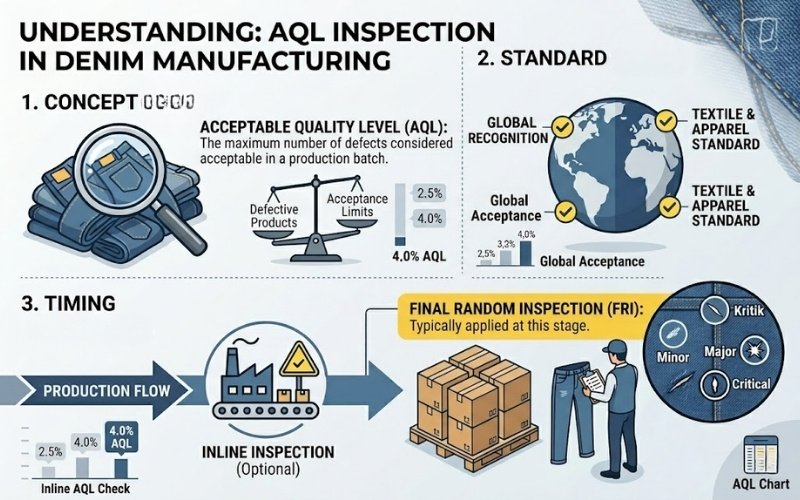
AQL stands for Acceptable Quality Limit. In apparel manufacturing, it refers to a statistical sampling approach used to determine whether a production lot should be accepted or rejected based on the number and classification of defects found in a representative sample.
Unlike a 100% inspection, AQL inspection does not require every garment in a production order to be examined. Instead, an inspection sample is selected according to the applicable sampling plan. Inspectors then examine the selected garments and compare the observed defects with the agreed acceptance and rejection criteria.
For denim manufacturers, this approach is particularly useful for bulk production because orders may contain thousands of garments. A structured sampling system allows buyers and manufacturers to evaluate production quality efficiently while maintaining a defined level of statistical control.
AQL inspection should therefore be understood as one component of a broader jeans manufacturing QC process. Fabric inspection, production-line controls, measurement checks, washing controls and final inspection can work together to identify and prevent quality problems.
How Does AQL Inspection Work for Denim Garments?
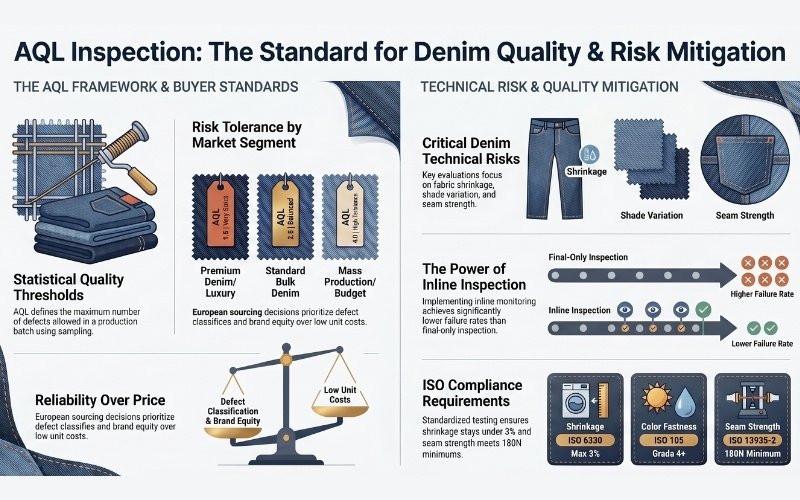
An AQL inspection normally begins by defining the production lot, inspection level and applicable AQL values. The inspector then determines the required sample size according to the relevant sampling plan. Selected garments are examined for predefined defects and the results are recorded.
The basic process can be summarized as follows:
- Define the production lot: Identify the quantity and product grouping being inspected.
- Select the inspection plan: Establish the applicable sampling level and AQL criteria.
- Determine the sample size: Select a statistically appropriate number of garments.
- Inspect the garments: Check appearance, construction, measurements, washing, labeling and other buyer requirements.
- Classify defects: Separate critical, major and minor defects according to the agreed quality standard.
- Compare results: Compare the number of observed defects with the applicable acceptance and rejection criteria.
- Approve or reject the lot: Determine whether the production batch meets the agreed inspection requirements.
The exact sampling plan should be agreed between the buyer and manufacturer before production or inspection begins. AQL values should not be interpreted independently from the applicable sampling standard, inspection level and defect classification system.
Understanding AQL 1.5, AQL 2.5 and AQL 4.0
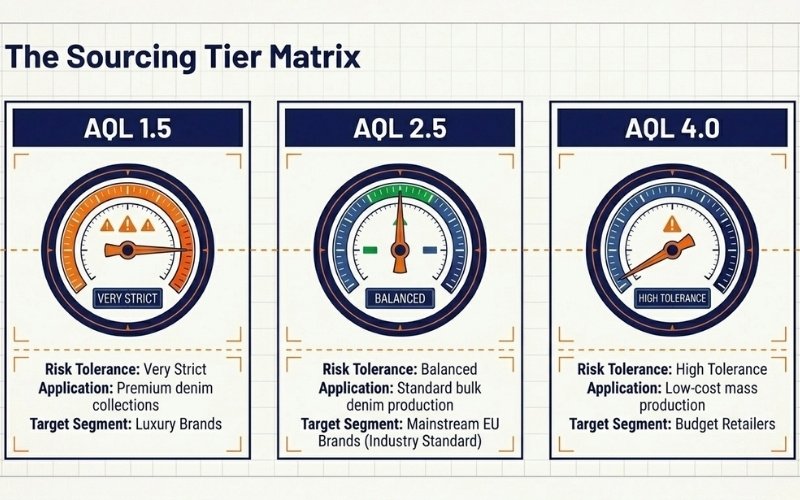
Different buyers may specify different AQL values depending on product positioning, risk tolerance and commercial requirements. AQL 1.5, AQL 2.5 and AQL 4.0 are commonly referenced values in apparel quality discussions, but they should not be treated as universal quality grades for every denim product.
| AQL Value | Typical Use Context | General Interpretation |
|---|---|---|
| AQL 1.5 | Premium or highly controlled production | Lower acceptable quality limit and stricter acceptance criteria |
| AQL 2.5 | Standard commercial apparel production | Common balance between quality control and production practicality |
| AQL 4.0 | Higher-volume or less restrictive applications | Greater statistical tolerance within the agreed inspection plan |
An important distinction is that AQL 1.5 does not mean 1.5% of garments are automatically allowed to contain defects. AQL is not a simple percentage-based pass/fail calculation applied directly to the entire order. The actual acceptance and rejection criteria depend on the sampling plan, sample size and number of defects detected.
For this reason, professional buyers should specify the applicable inspection standard and acceptance criteria rather than simply stating an AQL number without further context.
AQL Sampling and Acceptable Defect Levels
AQL inspection is based on sampling because inspecting every garment may not be commercially practical for large production orders. The sample is intended to provide a statistically meaningful indication of the quality of the overall production lot.
Defects are generally classified according to their potential impact on product functionality, appearance and consumer safety. In apparel quality control, manufacturers and buyers commonly distinguish between critical, major and minor defects.
- Critical defects: Conditions that may create a safety, regulatory or serious functional concern.
- Major defects: Defects that significantly affect garment appearance, construction, functionality or usability.
- Minor defects: Less significant deviations that may affect appearance but do not materially compromise garment functionality.
The buyer’s technical specification should define how individual defects are classified. The same visual issue may have different commercial importance depending on the garment design, product positioning and agreed quality requirements.
What Defects Are Checked During Denim AQL Inspection?
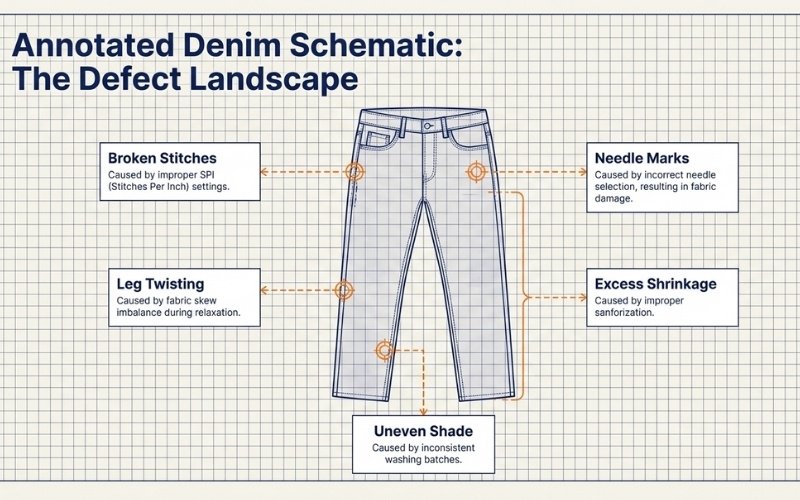
Denim inspection covers multiple quality characteristics because jeans are complex garments combining fabric, sewing, washing, hardware and finishing processes. A final inspection should therefore evaluate more than visual appearance alone.
Common Denim Defect Categories
- Incorrect measurements
- Uneven stitching
- Skipped or broken stitches
- Open seams
- Incorrect bartack placement
- Fabric holes or damage
- Shade variation
- Uneven washing
- Incorrect distressing
- Wrinkles or unwanted marks
- Incorrect hardware placement
- Broken buttons or rivets
- Incorrect labels
- Incorrect size or care information
- Packaging and assortment errors
The inspection checklist should be developed according to the garment specification rather than relying on a generic checklist. Denim designs with special washes, distressing, coatings or decorative treatments may require additional inspection criteria.
Denim Quality Control: What Inspectors Check
A comprehensive denim quality control system evaluates the garment from several technical perspectives. The objective is to confirm that bulk production remains consistent with the approved sample, technical specification and buyer requirements.
Measurement and Fit Control
Measurements are particularly important in jeans manufacturing because relatively small dimensional differences can influence fit and customer satisfaction. Inspectors may verify waist, hip, thigh, knee, inseam, outseam, front rise and other buyer-defined measurement points.
Measurement tolerances should always be established in the technical specification or measurement chart. The acceptable tolerance may vary by product, measurement point and buyer requirement.
Stitching and Construction Inspection
Construction quality includes stitch density, seam appearance, thread tension, bartacks, pocket attachment, waistband construction and other structural details. Particular attention should be paid to stress areas such as pocket openings, belt loops, crotch seams and seat seams.
Consistent sewing quality helps reduce seam failures, rework and customer complaints while supporting repeat production consistency.
Fabric Inspection
Fabric quality can affect the appearance and performance of the finished garment. Before cutting and during production, manufacturers may monitor fabric defects, shade variation, weaving irregularities and other characteristics defined by the buyer.
Early fabric inspection is important because identifying a fabric problem before cutting can prevent the defect from being multiplied across a large number of garments.
Washing and Finishing Inspection
Denim washing is one of the most technically sensitive stages of production. Garments may require stone washing, enzyme washing, bleaching, tinting, whiskering, hand sanding, laser effects or other finishing techniques.
Quality control should verify that the finished wash matches the approved reference. Color, contrast, hand feel, distressing placement and overall appearance should be evaluated against the agreed sample or wash standard.
Inline Inspection vs Final Random Inspection
AQL inspection is most effective when it is integrated into a broader quality management system rather than used as the only quality checkpoint. Two important approaches are inline inspection and final random inspection (FRI).
| Inspection Stage | Main Purpose | Typical Focus |
|---|---|---|
| Fabric Inspection | Identify material problems before production | Fabric defects, shade and structural consistency |
| Inline Inspection | Detect production problems during manufacturing | Sewing, measurements, construction and workmanship |
| Final Inspection | Evaluate completed garments before shipment | Appearance, measurements, defects, labeling and packing |
| AQL Inspection | Apply statistical sampling to the inspection lot | Defect classification and acceptance/rejection criteria |
Inline inspection is preventive because defects can be identified while production is still underway. Final inspection is corrective and evaluative because it provides a final assessment of completed production before shipment.
Combining both approaches can provide stronger quality visibility than relying exclusively on a final inspection.
How AQL Inspection Applies to Jeans Manufacturing
Jeans manufacturing involves multiple production stages, meaning quality deviations can originate from different parts of the process. Cutting, sewing, washing, finishing, pressing and packing can each influence the final product.
A structured quality system should therefore connect the approved product specification with measurable production controls.
- Pattern and cutting: Verify panel dimensions and cutting accuracy.
- Sewing: Monitor construction, seam quality and stitch consistency.
- Hardware: Check buttons, rivets, zippers and other components.
- Washing: Compare color and finishing against the approved standard.
- Measurement: Verify finished garment dimensions.
- Finishing: Check loose threads, pressing and overall presentation.
- Packing: Verify labels, sizes, quantities and carton assortment.
This layered approach helps manufacturers identify the source of quality deviations rather than discovering every problem only after bulk production has been completed.
Fabric, Washing and Color Quality Control
Denim differs from many other apparel categories because washing and finishing are fundamental components of the product’s visual identity. Two jeans produced from the same base fabric can have substantially different appearances depending on washing recipes and finishing techniques.
Quality teams therefore compare production garments with approved references and buyer specifications. Depending on the project, controls may include shade consistency, wash appearance, dimensional stability, surface effects and finishing uniformity.
Where specific laboratory testing is required, the applicable test method and acceptance criteria should be defined by the buyer’s technical specification. Standards such as ISO 6330 may be relevant to textile washing and dimensional change testing, while ISO 105 covers various textile color-fastness test methods. The exact test method and pass criteria depend on the characteristic being evaluated and the buyer’s requirements.
How to Reduce AQL Failure Rates in Denim Production
The most effective way to improve AQL results is to prevent defects before the final inspection rather than relying on final inspection to identify them. Quality should be controlled throughout production.
- Use approved fabric and trim standards before bulk production.
- Confirm measurement specifications before cutting.
- Maintain consistent sewing machine settings and thread tension.
- Monitor critical construction points during production.
- Standardize washing and finishing recipes.
- Compare bulk production with approved wash and fit samples.
- Perform inline measurement and workmanship checks.
- Correct recurring defects at their source.
- Conduct final inspection before shipment preparation.
- Maintain documented inspection records for traceability.
The strongest quality systems prevent recurring defects at the production stage instead of depending exclusively on final inspection to discover them.
Why AQL Matters to European Denim Buyers
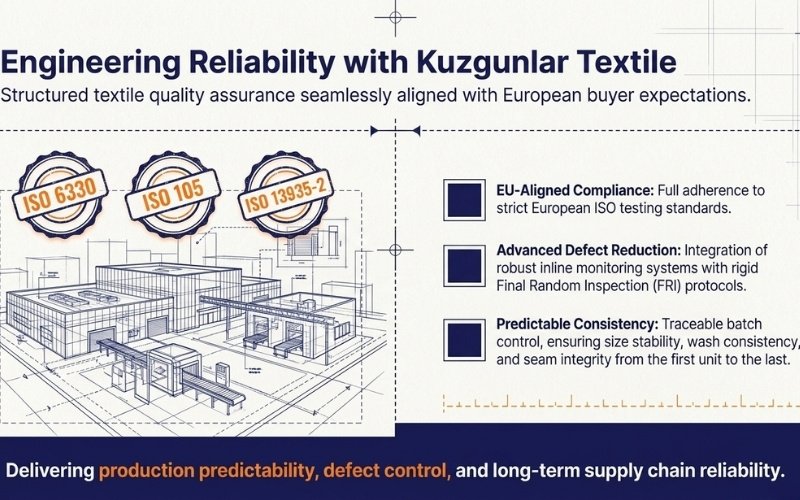
European fashion buyers increasingly require measurable quality processes because inconsistent production can create returns, markdowns, customer complaints and reputational damage. For importers purchasing thousands of garments, even a relatively small quality problem can become commercially significant when multiplied across a production lot.
AQL provides a common quality-control language between manufacturers, buying offices, sourcing companies and international buyers. Instead of relying solely on subjective descriptions such as “good quality,” buyers can define inspection criteria, defect classifications and acceptance parameters in advance.
For European brands, this supports a more transparent sourcing relationship and makes quality discussions easier to document throughout repeat production orders.
What Should Buyers Include in an AQL Inspection Protocol?
Before production begins, buyers should define the quality requirements that will be used during inspection. A clear inspection protocol reduces disagreements because both manufacturer and buyer understand what constitutes an acceptable production result.
- Applicable AQL value and sampling standard
- Inspection level
- Production lot definition
- Critical, major and minor defect classifications
- Measurement points and tolerances
- Approved fabric and color references
- Washing and finishing requirements
- Stitching and construction standards
- Hardware specifications
- Labeling and packaging requirements
- Applicable laboratory testing requirements
- Final inspection and shipment approval procedure
These requirements should be documented in the technical specification or quality manual before bulk production starts. Clear specifications allow the manufacturer to establish appropriate production controls before problems occur.
AQL Inspection at Kuzgunlar Textile
At Kuzgunlar Textile, quality control is approached as a production process rather than a single inspection event. Our denim manufacturing operations are structured around product specifications, production controls and inspection procedures designed to support consistent results across bulk orders.
Our quality approach can include fabric checks, inline production monitoring, measurement verification, workmanship inspection, washing and finishing controls, and final inspection according to the requirements established for each project.
For international buyers, the objective is to create a clear connection between the approved sample, technical specifications and finished production. This helps reduce avoidable deviations and provides greater visibility throughout the manufacturing process.
As a Turkey-based denim manufacturer and exporter, Kuzgunlar Textile works with international fashion businesses seeking custom denim manufacturing in Turkey, private label production and export-ready denim garments.
AQL Inspection as Part of a Reliable Denim Supply Chain
Quality control should not operate separately from sourcing, production planning and logistics. A failed inspection can affect shipment schedules, inventory availability and retail launch dates. For this reason, quality planning should begin before bulk manufacturing and continue through final shipment preparation.
A reliable denim supply chain connects several elements:
- Accurate product specifications
- Approved samples and references
- Controlled raw materials
- Process-level quality monitoring
- Documented inspection procedures
- Final AQL-based assessment where required
- Corrective action for recurring defects
- Shipment and documentation control
This integrated approach is particularly valuable for brands placing repeat orders because consistent quality must be maintained not only within one production batch but also across subsequent collections and replenishment programs.
Work with a Denim Manufacturer Focused on Quality Control
For international fashion brands, choosing a denim manufacturer involves evaluating more than production capacity or unit price. Quality systems, technical communication, production consistency and export experience can directly influence the commercial success of a denim collection.
Kuzgunlar Textile provides Turkey-based denim manufacturing for international buyers seeking jeans, denim jackets, denim shirts, distressed denim and custom denim garments. Our production approach is designed to support both collection development and repeat bulk manufacturing.
Brands interested in custom production can explore our private label jeans manufacturing solutions, while buyers can review our denim collections to understand our product capabilities.
If your company is evaluating Turkish denim manufacturers and requires defined quality-control procedures for an upcoming collection, contact the Kuzgunlar Textile team to discuss your product specifications, inspection requirements and production objectives.
Conclusion
AQL inspection is an important statistical quality-control method for denim manufacturing, but it should be viewed as part of a broader production quality system. Effective denim quality management combines material inspection, process control, measurement verification, workmanship checks, washing control and final inspection according to agreed buyer requirements.
For European and international buyers, a clearly defined AQL protocol provides a practical framework for evaluating bulk production and managing quality risk. When combined with preventive inline controls and documented technical specifications, it can help manufacturers maintain more consistent production across large denim orders.
Kuzgunlar Textile combines Turkey-based denim manufacturing with export-oriented production management to support fashion brands, retailers, wholesalers and importers seeking reliable denim sourcing. Our focus is on establishing measurable production requirements and maintaining consistency from product development through bulk manufacturing and shipment.
Frequently Asked Questions About AQL Inspection in Denim Manufacturing
What is AQL in denim manufacturing?
AQL, or Acceptable Quality Limit, is a statistical sampling methodology used to determine whether a production lot meets predefined quality requirements. It does not mean that a specific percentage of garments can automatically contain defects.
Is AQL inspection the same as 100% inspection?
No. AQL inspection is based on statistical sampling, meaning only a defined sample of garments is inspected according to the applicable sampling plan. A 100% inspection examines every garment and is a different quality-control approach.
What is AQL 2.5 in garment manufacturing?
AQL 2.5 is a commonly referenced AQL value in commercial apparel production. Its actual acceptance and rejection criteria depend on the applicable sampling standard, inspection level and sample size.
What is the difference between AQL 1.5 and AQL 2.5?
AQL 1.5 represents a stricter acceptable quality limit than AQL 2.5 within the same applicable sampling framework. The appropriate value depends on the buyer’s quality requirements, product positioning and risk tolerance.
What defects are checked during denim AQL inspection?
Common checks include stitching defects, open seams, measurement deviations, fabric damage, shade variation, washing inconsistencies, hardware problems, labeling errors and packaging issues. The exact checklist depends on the buyer’s technical specification.
What is final random inspection in denim manufacturing?
Final random inspection, or FRI, is a quality assessment performed on a representative sample of completed garments before shipment. When an AQL sampling system is specified, the inspection results are evaluated against the agreed acceptance and rejection criteria.
Why is inline inspection important in jeans manufacturing?
Inline inspection identifies production problems while manufacturing is still in progress. Detecting sewing, measurement or construction defects early can reduce rework and prevent recurring problems from reaching the finished-garment stage.
Does AQL guarantee defect-free denim production?
No. AQL is a statistical quality-control methodology and does not guarantee that every garment in a production lot is defect-free. It establishes an agreed statistical basis for accepting or rejecting the inspected lot.
Which quality standards are relevant to denim manufacturing?
The applicable standards depend on the product and buyer requirements. Textile testing may involve standards such as ISO 6330 for certain washing and dimensional-change procedures, ISO 105 for color-fastness testing and ISO 13935-2 for seam tensile properties.
Can Kuzgunlar Textile support AQL-based quality requirements?
Yes. Kuzgunlar Textile can work with international buyers to establish production and inspection requirements according to the technical specifications agreed for each denim manufacturing project.