Denim Production Process Explained: From Fabric to Finished Jeans
Denim is far more than a basic textile. In modern apparel manufacturing, it represents a complex intersection of material science, industrial engineering, craftsmanship, and sustainability. For fashion brands, sourcing teams, and private label buyers, understanding the denim production process is essential to ensuring product consistency, long-term durability, and brand credibility.
>> Denim Production Process Guide
This in-depth guide explains how denim jeans are made, covering every stage of the jeans manufacturing process—from fabric selection to final inspection—while highlighting the technologies and decisions that directly impact quality and performance.
🧵 Introduction to Denim Manufacturing
Denim garment manufacturing differs significantly from standard apparel production. Denim garments are exposed to high mechanical stress during wear and washing, which means every production stage must meet strict technical standards.
A professionally managed industrial jeans production process ensures:
-
Consistent sizing across collections
-
Stable wash results
-
Long product lifespan
-
Lower return and complaint rates
For brands working with large volumes or international markets, production transparency is no longer optional—it is a competitive necessity.
🧶 Denim Fabric Selection and Preparation
🔹 Denim Fabric Production: The Foundation of Quality
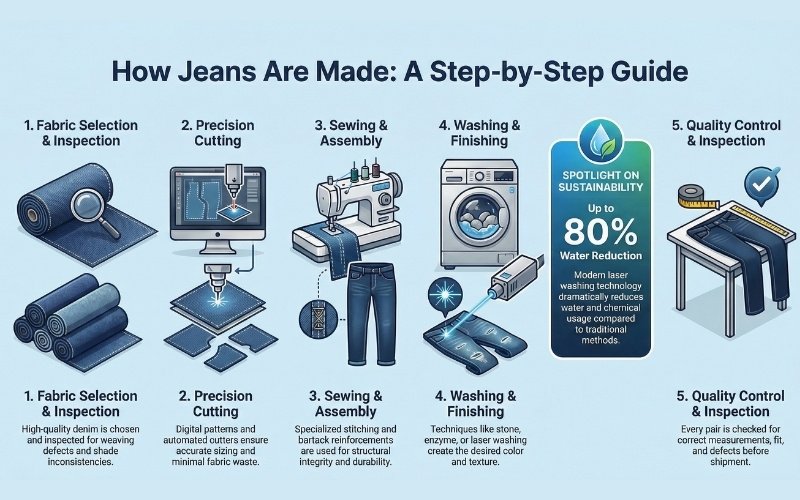
Every successful pair of jeans starts with the right fabric. Denim fabric production determines not only the visual identity of the garment but also its comfort, stretch recovery, and resistance to deformation.
Common denim fabric types include:
-
Raw denim (unwashed, rigid structure)
-
Stretch denim (with elastane for comfort)
-
Selvedge denim (premium woven edges)
-
Recycled or sustainable denim fabrics
Each fabric type requires a different handling approach throughout the denim production process.
🔹 Fabric Inspection and Quality Standards
Before entering production, fabrics undergo strict inspection procedures. Quality control in denim manufacturing begins at this stage to identify:
-
Weaving defects
-
Shade and tone inconsistencies
-
Weight and density variations
Early detection minimizes material waste and prevents downstream production issues.
✂️ Cutting Process in Industrial Denim Production
🔹 Pattern Making and Marker Planning
Precision is critical in industrial jeans production. Digital pattern making and marker planning ensure accurate sizing and optimized fabric utilization, especially in a mass production jeans factory environment.
Marker efficiency directly affects:
-
Fabric consumption
-
Cost per unit
-
Production scalability
🔹 Precision Cutting Techniques for Mass Production
Modern factories rely on CNC or automated cutting systems to maintain consistency. This stage marks the operational start of denim cutting sewing finishing workflows.
Benefits include:
-
Minimal measurement deviations
-
Faster production cycles
-
Reduced human error
🪡 Sewing and Assembly of Denim Garments
🔹 Stitching Techniques Used in Jeans Manufacturing
The sewing stage defines structural integrity. In the jeans manufacturing process, industrial machines apply specialized stitching methods such as:
-
Chain stitch
-
Lock stitch
-
Bartack reinforcements
High-stress areas—pockets, belt loops, inseams—are reinforced to withstand long-term wear.
🔹 Reinforcement Areas and Durability Factors
In professional denim garment manufacturing, durability is engineered, not assumed. Stitch density, thread quality, and reinforcement placement all contribute to product longevity.
🧼 Denim Washing and Finishing Processes
🔹 Common Denim Washing Techniques
Washing and finishing transform raw garments into market-ready products. The most widely used denim washing techniques include:
-
Stone wash
-
Enzyme wash
-
Bleach wash
-
Laser wash denim
Each method affects color depth, hand feel, and surface texture.
👉 For a deeper technical breakdown, see our dedicated guide on Denim Washing Techniques Explained
🔹 Laser Wash Denim: Technology and Benefits
Laser wash denim has become a cornerstone of sustainable denim production. Compared to traditional methods, it offers:
-
Up to 80% water reduction
-
Minimal chemical usage
-
Highly repeatable visual effects
This technology allows brands to achieve consistent aesthetics while meeting environmental targets.
⭐ What Is the Denim Production Process?
The denim production process is the industrial workflow that transforms denim fabric into finished jeans through fabric selection, cutting, sewing, washing, finishing, and quality control. Each stage directly impacts the garment’s durability, fit consistency, and overall quality.
🔍 Quality Control and Final Inspection
🔹 Measurements, Fit Consistency, and Defect Checks
Final inspection is a non-negotiable step in quality control in denim manufacturing. Garments are evaluated for:
-
Measurement accuracy
-
Symmetry and fit
-
Stitch integrity
-
Wash consistency
Only approved products proceed to packaging.
🔹 Packaging and Preparation for Shipment
Finished jeans are tagged, folded, and packed according to brand-specific requirements. For B2B clients, this stage may include custom labeling and compliance documentation.
🌱 Sustainable Denim Production Practices
🔹 Water-Saving and Energy-Efficient Technologies
Modern sustainable denim production focuses on reducing environmental impact without compromising quality. Key solutions include:
-
Ozone washing systems
-
Laser finishing
-
Low-energy machinery
🔹 Eco-Friendly Denim Manufacturing Trends
Eco-friendly denim manufacturing is no longer a niche concept. Global brands increasingly prioritize suppliers that align with sustainability certifications and transparent production practices.
🧠 Why the Denim Production Process Matters for Brands
A well-structured denim production process is a strategic asset. It enables brands to:
-
Maintain consistent product quality
-
Control production costs
-
Scale collections reliably
-
Build long-term consumer trust
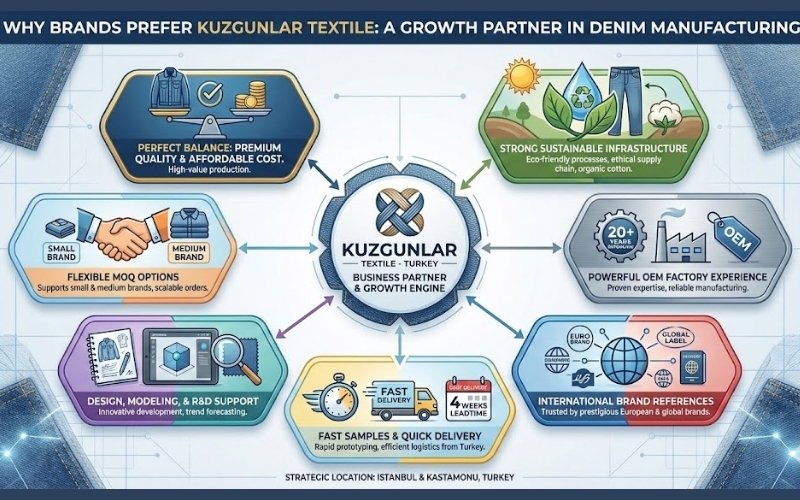
For companies seeking custom denim manufacturing in Istanbul or working with a private label jeans manufacturer, production expertise is often the deciding factor in supplier selection.
Kuzgunlar Textile positions itself not as a standard factory, but as a private label denim production partner.
❓ Frequently Asked Questions
How long does the denim production process take?
Depending on order volume and washing techniques, production typically takes 4 to 8 weeks.
What is the most sustainable denim washing method?
Laser wash denim and ozone washing are currently the most resource-efficient options.
What is the difference between raw denim and washed denim?
Raw denim is untreated fabric, while washed denim undergoes various denim washing techniques to achieve specific looks and softness.
How is quality ensured in mass production jeans factories?
Through multi-stage quality control in denim manufacturing, including fabric inspection, in-process checks, and final audits.
Can denim production be customized for private label brands?
Yes. Private label jeans manufacturer models allow full customization—from fabric and fit to washing and branding.
How to differantiate your private label jeans? Click to learn!
Pricing strategy for wholesale denim, Click to learn!
Does Low MOQ Jeans Production Reduce Profitability? Click to learn!
How Do Denim Wash Techniques Affect Pricing? Click to learn!