
Choosing the right denim manufacturer is one of the most important decisions a fashion brand makes before starting a new collection. The right supplier must do more than produce jeans. Brands should evaluate manufacturing capability, sample development, fabric sourcing, quality control, MOQ, lead times, washing expertise, communication and export experience before placing a production order.
For fashion companies developing jeans, denim jackets, denim shirts or private label collections, manufacturer selection directly affects product consistency, delivery performance and the ability to scale future collections.
Working with an experienced denim manufacturer in Turkey can provide international brands with an integrated production structure, geographic proximity to European markets and access to established denim manufacturing expertise. However, geographic location alone should never be the only selection criterion.
A reliable denim manufacturer should be evaluated by what it can consistently deliver across sampling, production, quality control, washing, delivery and repeat orders—not only by its initial quotation.
This guide explains the most important criteria fashion brands should consider when selecting a denim manufacturing partner and how to compare potential suppliers before committing to bulk production.
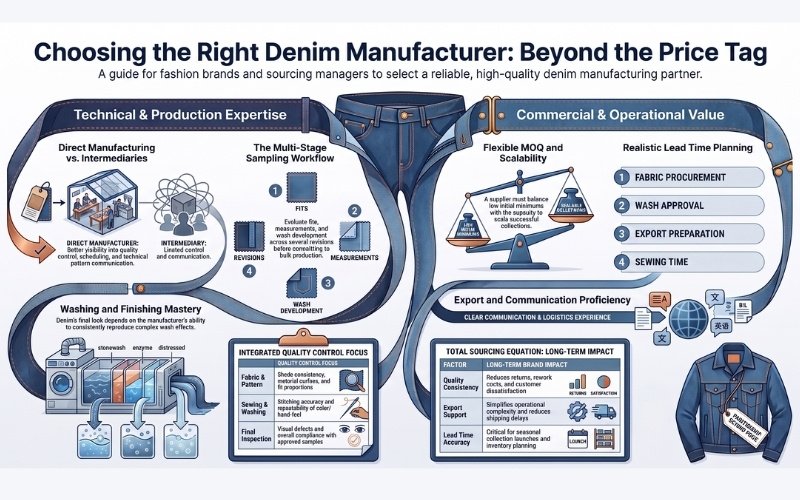
What Should You Look for in a Denim Manufacturer?
The best denim manufacturer for one fashion brand may not be the best choice for another. A startup developing a small private label collection has different requirements from an established retailer ordering thousands of garments across multiple styles.
Before requesting a quotation, brands should define their product requirements and evaluate manufacturers against measurable criteria.
| Selection Criteria | What the Brand Should Evaluate |
|---|---|
| Manufacturing Capability | Production stages, equipment, technical expertise and garment categories. |
| Sampling | Ability to develop patterns, prototypes, fits and wash samples. |
| MOQ | Minimum order requirements by style, fabric and production configuration. |
| Quality Control | Fabric inspection, inline controls, measurement checks and final inspection. |
| Washing Expertise | Ability to reproduce approved washes consistently during bulk production. |
| Lead Time | Realistic sampling, production and shipment planning. |
| Export Experience | Experience preparing international shipments and working with overseas buyers. |
| Communication | Technical communication, production updates and response times. |
| Scalability | Ability to support higher volumes and repeat collections as the brand grows. |
These criteria should be considered together. A supplier offering a low MOQ may not have the production capacity required for future growth, while a large factory may not provide the flexibility needed by a developing fashion label.
1. Check Whether the Manufacturer Actually Produces Denim
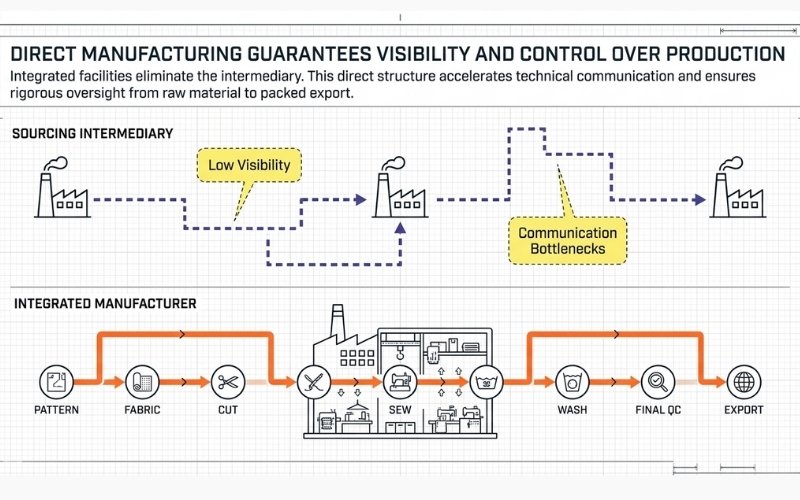
One of the first questions brands should ask is whether the company operates its own manufacturing facilities or primarily acts as a sourcing intermediary.
This distinction matters because direct manufacturing can provide greater visibility into production, quality control and scheduling. It can also make technical communication easier when brands need changes to patterns, stitching, washing or measurements.
A manufacturer should be able to explain its production structure clearly. Ask which stages are handled internally and which processes are outsourced.
- Pattern development
- Fabric sourcing and inspection
- Cutting
- Embroidery or other decorative processes
- Sewing
- Washing and dyeing
- Finishing
- Measurement control
- Final quality inspection
- Packing and export preparation
Kuzgunlar Textile operates integrated manufacturing facilities in Turkey and manages multiple stages of denim production through its production structure. This allows international buyers to work with a manufacturer rather than relying exclusively on an intermediary sourcing model.
You can review the company’s manufacturing structure and production capabilities on the Kuzgunlar Textile website.
2. Evaluate the Denim Sampling Process
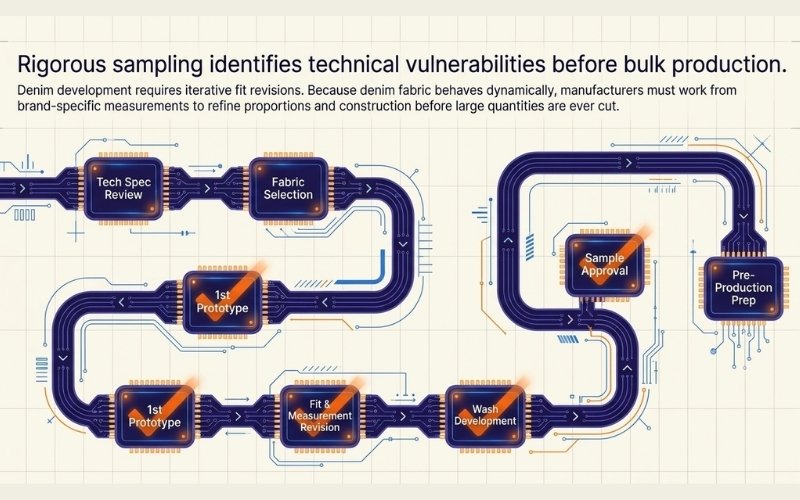
A production order should not begin with an assumption that the first sample will become the final product. Denim development usually requires technical evaluation, fit revisions and approval before bulk manufacturing.
The sampling process should allow the brand and manufacturer to identify problems before large quantities are produced.
A professional denim sampling workflow may include:
- Technical specification review
- Fabric selection
- Pattern development
- First prototype
- Fit evaluation
- Measurement revisions
- Wash development
- Sample approval
- Pre-production preparation
Brands should ask potential suppliers how many development stages are normally required and who is responsible for technical revisions.
Fit is particularly important in denim because small measurement differences can significantly affect the appearance and comfort of jeans. A manufacturer should therefore be able to work from brand-specific measurements rather than simply adapting a generic pattern.
3. Ask About MOQ Before Comparing Prices
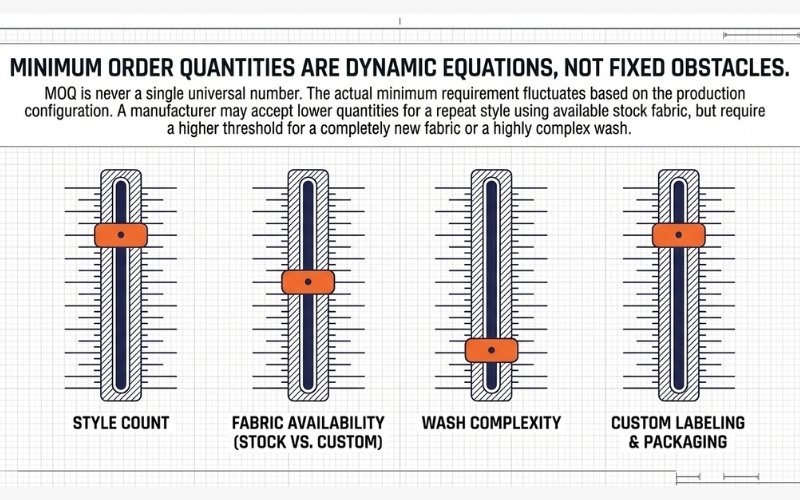
Minimum order quantity (MOQ) is one of the most important commercial considerations when choosing a denim manufacturer.
However, MOQ should not be viewed as a single number. The actual minimum may depend on style count, fabric availability, wash requirements, customization and production planning.
For example, a manufacturer may accept a lower quantity for a repeat style using an available fabric but require a different production quantity for a completely new fabric or complex wash.
Before requesting a quotation, clarify:
- MOQ per style
- MOQ per color or wash
- Fabric minimums
- Sample requirements
- Custom labeling requirements
- Packaging requirements
- Repeat-order conditions
For brands specifically searching for smaller production quantities, our guide to low MOQ jeans production in Turkey provides additional information about the factors that influence smaller denim orders.
4. Understand the Manufacturer’s Quality Control System
Quality control should be evaluated before production begins rather than after the finished garments are ready for shipment.
A denim manufacturer should have defined quality checkpoints covering both materials and finished garments. Depending on the project, these controls can include fabric inspection, measurements, stitching, construction, washing consistency and final visual inspection.
Ask the manufacturer:
- How is incoming denim fabric inspected?
- How are measurements controlled during production?
- How are sewing defects identified?
- How is wash consistency checked?
- How are approved samples compared with bulk production?
- Is final inspection performed before shipment?
- Can the factory provide inspection records when required?
For larger production orders, brands may also specify an AQL-based inspection procedure. The current ISO 2859-1:2026 standard defines acceptance sampling schemes indexed by AQL for lot-by-lot inspection. It is a sampling methodology rather than a guarantee that every garment in a lot is defect-free. :contentReference[oaicite:1]{index=1}
Our detailed guide explains AQL inspection in denim manufacturing, including how sampling-based quality control can be incorporated into denim production.
5. Look Beyond Final Inspection
A final inspection is important, but quality should not depend exclusively on checking finished garments.
Problems detected late in production can be more expensive and difficult to correct. For this reason, brands should ask whether quality controls are integrated into earlier production stages.
A practical denim quality-control structure can include:
| Production Stage | Quality Focus |
|---|---|
| Fabric Inspection | Shade, construction, surface and material consistency. |
| Pattern Development | Measurements, proportions and fit structure. |
| Cutting | Panel accuracy and size consistency. |
| Sewing | Stitching, construction and component placement. |
| Washing | Color, appearance, hand feel and repeatability. |
| Finishing | Trims, threads, pressing and garment presentation. |
| Final Inspection | Measurements, visual defects and overall compliance. |
This multi-stage approach gives brands greater control over production than relying exclusively on a final random inspection.
6. Examine Denim Washing and Finishing Expertise
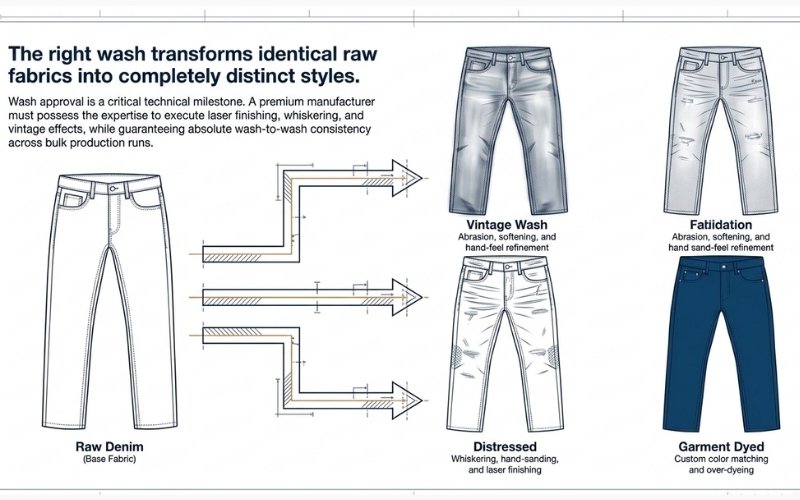
Denim washing is one of the areas where manufacturer capability can have a major effect on the final appearance of a garment.
Two jeans made from similar denim fabric can look completely different because of washing, dyeing, abrasion, finishing and other treatments.
When evaluating a manufacturer, ask whether it can develop and reproduce the required wash consistently.
Important considerations include:
- Wash development
- Color matching
- Vintage effects
- Whiskering
- Distressing
- Softening
- Garment dyeing where applicable
- Laser or other finishing techniques
- Wash-to-wash consistency
Wash approval should be treated as a technical production milestone. A brand should approve the target appearance before bulk production rather than relying on verbal descriptions alone.
7. Review the Complete Jeans Production Process
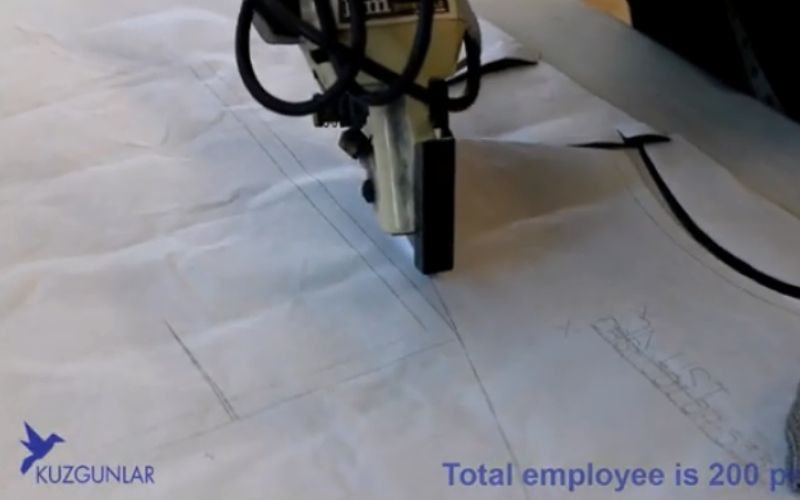
A manufacturer should be able to explain how a garment moves from technical specification to finished product.
Understanding this workflow helps brands identify where production risks may occur.
A typical industrial denim production process includes fabric preparation, pattern development, cutting, sewing, washing, finishing, quality control and packing. Each stage can influence fit, appearance and final garment consistency.
For a detailed stage-by-stage explanation, see our guide to the jeans production process in Turkey.
8. Evaluate Lead Times Realistically
Lead time should never be judged only by the number of weeks stated in an initial quotation.
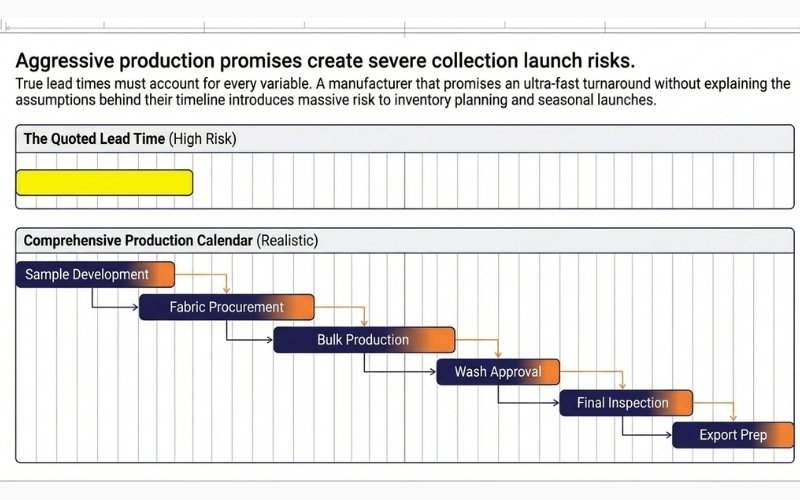
The total production calendar may include development, sampling, fabric procurement, wash approval, bulk production, inspection and shipment preparation.
Before placing an order, ask the manufacturer to distinguish between:
- Sample development time
- Fabric procurement time
- Production lead time
- Washing and finishing time
- Final inspection time
- Packing time
- Export preparation time
For seasonal fashion collections, these stages should be incorporated into the brand’s product launch calendar.
A manufacturer that provides an aggressive production promise without explaining the assumptions behind the timeline may create more risk than a supplier providing a realistic schedule.
9. Check Whether the Manufacturer Can Scale with Your Brand
A suitable supplier should meet today’s requirements without creating unnecessary limitations for future collections.
A fashion brand may begin with a small collection and later increase its number of styles, colors or order quantities. The manufacturer should therefore have a production structure capable of supporting growth.
Ask potential suppliers:
- Can production quantities increase for successful styles?
- Can repeat orders be scheduled efficiently?
- Can multiple denim categories be produced?
- Can new fits and washes be developed?
- Can production support seasonal collections?
- Is there sufficient capacity for future growth?
Scalability is especially important for private label brands. Changing manufacturers after a product becomes commercially successful can introduce unnecessary fit, fabric and wash inconsistencies.
10. Consider Private Label and Custom Manufacturing Capabilities
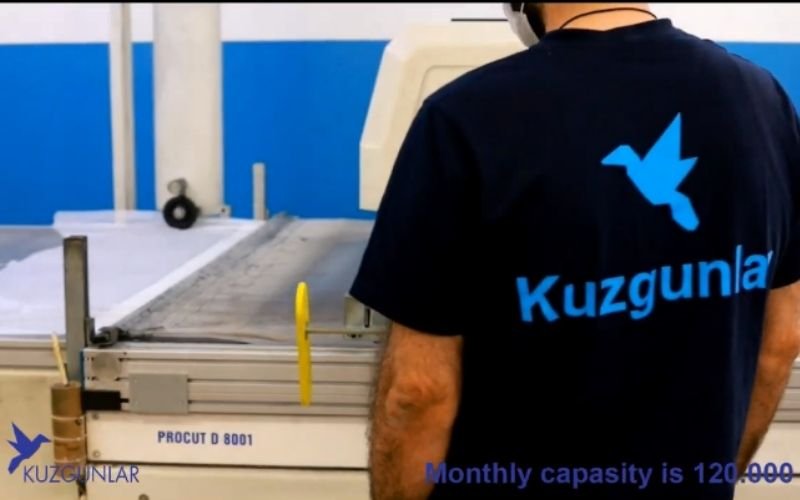
Fashion brands rarely want generic jeans with another company’s label attached. They usually need control over fit, fabric, washing, branding and product specifications.
A suitable private label denim manufacturer should therefore be able to work from brand-specific requirements.
Depending on the project, customization may include:
- Custom patterns and fits
- Denim fabric selection
- Custom washes
- Labels and branding
- Buttons and rivets
- Back-pocket design
- Embroidery
- Hangtags
- Packaging
- Custom garment specifications
Brands developing their own collections can review our custom denim jeans manufacturing capabilities to understand how customized production can be structured.
11. Verify Export Experience
Manufacturing and exporting are related but different capabilities.
A factory may produce high-quality garments but still lack the export processes required by international buyers. Brands working across borders should therefore evaluate the supplier’s experience with international shipments and commercial documentation.
Relevant questions include:
- Which international markets does the manufacturer serve?
- How are shipments coordinated?
- Who prepares export documentation?
- Which transportation options are available?
- How are packing requirements managed?
- Can the manufacturer coordinate with the buyer’s logistics provider?
For international brands, an experienced denim exporter from Turkey can simplify coordination between manufacturing, documentation and shipment preparation.
12. Assess Communication Before Placing an Order
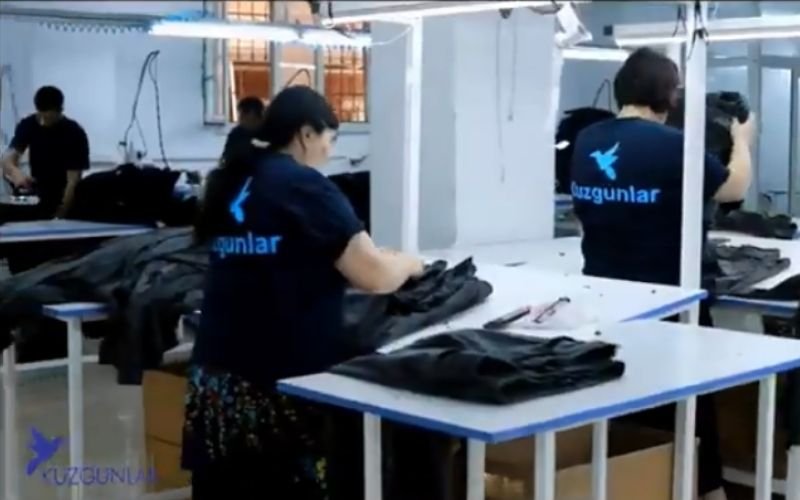
Communication problems often become production problems.
A manufacturer may have strong machinery and production capacity, but if technical specifications are misunderstood, the final garment may still fail to meet the brand’s expectations.
During the initial sourcing stage, evaluate how the supplier handles technical questions.
- Are specifications reviewed carefully?
- Are unclear points identified before production?
- Are sample revisions documented?
- Are production changes communicated clearly?
- Are approval stages defined?
- Can the manufacturer communicate effectively in English?
- Are production updates provided when required?
Good communication is not simply a customer-service advantage. It is part of technical quality management.
13. Compare Manufacturers by Total Value, Not Unit Price
The cheapest quotation is not necessarily the lowest-cost manufacturing option.
A lower unit price can become expensive if it results in inconsistent measurements, repeated samples, delayed production, excessive defects or missed delivery windows.
Instead of comparing only the price per garment, brands should evaluate the complete sourcing equation.
| Factor | Potential Impact |
|---|---|
| Unit Price | Direct production cost. |
| Sample Development | Affects development time and initial investment. |
| Quality Consistency | Influences returns, rework and customer satisfaction. |
| Lead Time | Affects collection launches and inventory planning. |
| MOQ | Influences inventory risk and cash flow. |
| Washing Capability | Determines whether target denim aesthetics can be reproduced. |
| Export Support | Influences shipment coordination and operational complexity. |
| Repeat Order Capability | Determines long-term sourcing stability. |
The most suitable supplier is therefore the manufacturer that offers the best combination of product quality, technical capability, commercial flexibility and operational reliability for the brand’s specific requirements.
14. Ask for a Clear Production Workflow
Before committing to bulk production, ask the manufacturer to explain the complete order workflow.
A structured workflow should normally identify the major approval points from initial inquiry through shipment.
- Initial project discussion
- Technical specification review
- Fabric and component evaluation
- Pattern development
- Sample production
- Fit and wash approval
- Production planning
- Bulk manufacturing
- Quality control
- Final inspection
- Packing
- Export preparation
- Shipment
This structure gives the buyer a clearer understanding of when decisions must be made and where approvals are required.
For brands that want to understand the international sampling standard in more detail, the ISO 2859-1 standard provides the framework for acceptance sampling procedures based on AQL values.
15. Use a Denim Manufacturer Evaluation Checklist
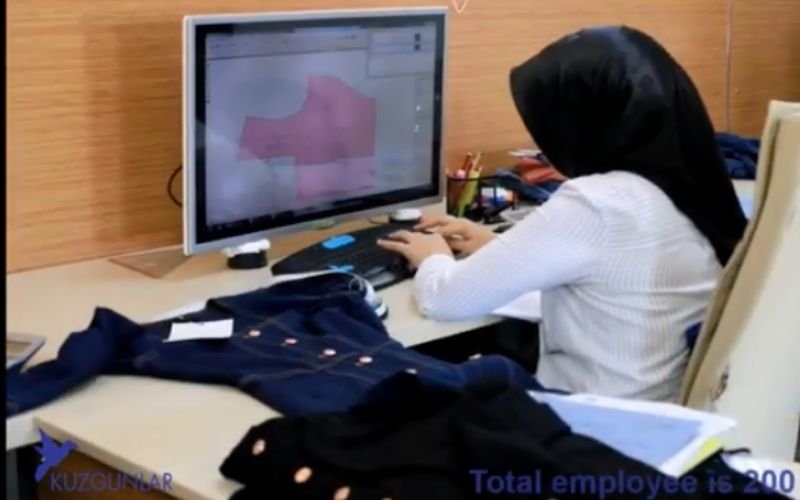
Before selecting a supplier, fashion brands can use a simple evaluation checklist.
| Question | Why It Matters |
|---|---|
| Does the company operate its own production facilities? | Helps determine production control and transparency. |
| Can it develop custom samples? | Important for new collections and private label products. |
| What is the MOQ? | Determines whether the supplier fits the commercial model. |
| How is quality controlled? | Helps assess production risk. |
| Can the factory reproduce approved washes? | Critical for denim appearance and consistency. |
| What are realistic lead times? | Supports collection and inventory planning. |
| Can production scale? | Important for growing brands and repeat orders. |
| Does the supplier have export experience? | Reduces international sourcing complexity. |
| How are technical changes communicated? | Reduces misunderstandings during development. |
| Can the supplier support long-term production? | Creates greater sourcing stability. |
Why Turkey Is Considered for Denim Sourcing
Turkey has an established textile and apparel manufacturing ecosystem and a geographic position that can be particularly useful for European fashion companies.
For brands sourcing from Europe, proximity can support faster communication, more practical sampling coordination and shorter transportation routes than many distant manufacturing locations.
However, the advantage of sourcing from Turkey should still be evaluated at the manufacturer level. Not every Turkish supplier has the same production structure, denim expertise, MOQ policy or quality-control system.
The important question is therefore not simply “Is Turkey a good place to source denim?” but rather:
“Does this specific Turkish manufacturer have the technical, commercial and export capabilities required by my brand?”
Why Work with Kuzgunlar Textile?
Kuzgunlar Textile is a Turkey-based denim manufacturer supporting international fashion brands with jeans, denim jackets, denim shirts, distressed denim and custom denim garments.
Our production approach combines product development, manufacturing, washing, quality control and export preparation within an integrated production structure.
For brands evaluating a long-term manufacturing partner, the focus is on creating a controlled production workflow rather than simply supplying finished garments.
- Integrated denim manufacturing facilities in Turkey
- Custom product development
- Private label production capabilities
- Multiple denim garment categories
- Structured quality-control processes
- Denim washing and finishing expertise
- Flexible production planning
- Export-oriented manufacturing
- Support for international fashion brands
The objective is to provide brands with a manufacturing partner capable of supporting the complete journey from product development to bulk production and export.
How to Choose the Right Denim Manufacturer: Final Decision
Choosing a denim manufacturer should be treated as a supplier evaluation process rather than a simple price comparison.
The right manufacturer should understand your product specifications, develop accurate samples, maintain consistent production quality, reproduce approved washes, communicate clearly and deliver according to an agreed production plan.
MOQ and price are important, but they should be evaluated alongside quality control, lead time, manufacturing capability and long-term scalability.
For a new fashion brand, the ideal supplier is not necessarily the largest factory. It is the manufacturer whose production structure matches the brand’s current requirements while providing enough flexibility to support future growth.
Kuzgunlar Textile works with international buyers seeking a reliable denim manufacturer in Turkey for custom, private label and collection-based production.
If you are evaluating suppliers for an upcoming denim collection, you can contact Kuzgunlar Textile with your product requirements, target quantities and development plans.
Conclusion
Choosing a denim manufacturer is a long-term sourcing decision that can influence product quality, production efficiency and brand growth. The strongest supplier relationships are built on clear technical specifications, controlled manufacturing processes, realistic production planning and consistent communication.
Fashion brands should therefore evaluate manufacturers across the complete production lifecycle rather than comparing quotations alone. Sampling, fabric selection, washing, quality control, MOQ, lead time, scalability and export capability all deserve consideration before a bulk order is approved.
For brands looking for a Turkey-based manufacturing partner, Kuzgunlar Textile provides integrated denim production and export-oriented support for international fashion businesses.
Frequently Asked Questions
Why do fashion brands choose denim manufacturers in Turkey?
Fashion brands choose Turkish denim manufacturers for their experienced production infrastructure, flexible manufacturing capabilities, competitive lead times and established export connections with European and international markets.
What products can a denim manufacturer in Turkey produce?
Turkish denim manufacturers can produce men’s jeans, women’s jeans, denim jackets, denim shirts, denim shorts, distressed jeans and custom denim garments according to buyer specifications.
Can I order custom jeans from a Turkish denim manufacturer?
Yes. Custom jeans can be developed according to specifications such as fabric, fit, measurements, washing, stitching, trims, labels and packaging requirements.
What is the MOQ for denim production in Turkey?
MOQ depends on the manufacturer, product type, fabric, washing process and customization requirements. Some Turkish manufacturers also provide low MOQ production options for emerging and growing fashion brands.
How long does it take to manufacture jeans in Turkey?
Production lead time depends on sampling, fabric availability, washing development, order quantity and technical specifications. The final production schedule is normally confirmed after the project requirements are reviewed.
Can Turkish denim manufacturers export directly to European buyers?
Yes. Export-oriented Turkish denim manufacturers can support European brands, retailers, wholesalers and importers with production, export preparation and shipment coordination.
How is denim quality controlled in Turkish factories?
Quality control can include fabric inspection, measurement verification, inline sewing checks, washing controls and final random inspection. AQL procedures may also be applied according to buyer requirements.
What should I check before choosing a denim manufacturer in Turkey?
Buyers should evaluate manufacturing capability, quality control, MOQ, production capacity, lead times, product development expertise, export experience and the manufacturer’s ability to maintain consistent quality across repeat orders.
Can Turkish manufacturers produce private label jeans?
Yes. Private label production can include custom designs, branded labels, trims, packaging and other specifications required to manufacture denim garments under the buyer’s own brand.
How can I start working with a denim manufacturer in Turkey?
Start by sharing your product specifications, target quantity, reference samples or designs and delivery requirements. The manufacturer can then evaluate the project and recommend a suitable production approach.